Eyes – our eyes – they are such communicative tools. Widening our eyes showcases shock, narrowing them conveys suspicion. Even the popular side-eye emoji ( 👀) comes from how our eyes express what we mean to display — it could be curiosity, interest or alertness in what is being discussed, and sometimes, as a shock too.
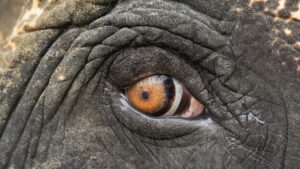
Elephants use their striking eyes, often in hues of brown, in a similar manner. They are known to widen their eyes when faced with stress, fear or even excitement, and keep them half-open when they’re at ease.
An elephant’s eyes are laterally positioned on both the sides of the head. This divides their vision into uniocular and binocular — the former being the ability to see using only one eye, while the latter is the coordinated use of both eyes together. Humans have eyes that are forward facing, which means we see the world using both eyes together. The side-facing eye placement gives elephants a good peripheral vision too, allowing them to see objects up or below without having to move their heads. Despite these aspects, elephants are nearsighted mammals, and can only see clearly up to 10 metres.
Another consequence of the placement of their eyes is that elephants have a blind spot right between their forelimbs. Perhaps this is how the myth of gentle giants being scared of mice came to be! Wouldn’t it be startling for the elephant if something they can’t see randomly runs along their feet? Elephants also remain blind to what is happening at the rear half of their body.
But what is amazing to note is that elephants closely observe whatever they can see.
And where the pachyderm’s eyes are looking tells us a lot about where their focus lies.
Experiences by behaviouralists at our elephant centres have documented a lot from this aspect, especially during target training sessions that take place. Target training for elephants is the process where the animal voluntarily participates in responding to cues that help caregivers and veterinarians to carry out routine medical examinations smoothly and stress-free. Wildlife SOS follows this process with positive reinforcements that include treats and gentle gestures that encourage and motivate elephants.
If the pachyderm is looking at the treat or the caregiver, they’re highly driven by food and knows from whom it will be coming from. Such visual focus also reveals how deeply involved the elephant is with the session. If the elephant is looking somewhere else altogether, it could be a sign of disinterest or distraction. In this case, the caregiver simply, and considerately, pauses the session. It is restarted only after regaining the elephant’s full attention to the cue, and of course, the awaiting treat!
A Small Eye
An elephant’s eye measures 3.8 cm diametrically on average. It’s not a small size for an eye… but we are speaking of a pair belonging to the largest land mammal on the planet! An interesting comparison for it would be the human eye, which is typically 2.4 cm in diameter.

A Vision in Two Colours
Elephants have dichromatic vision, meaning they see the world in only colours. To give the colours a palette, they perceive their surroundings in shades of blue and yellow. This is because their eyes contain only two types of cone receptors that absorb these limited colours. An intriguing study has revealed that elephant vision is remarkably similar to deuteranopia (the lack of perceiving green), a form of colourblindness humans have.

However, it does not necessarily mean that colourblind humans see exactly how elephants see. The study conducted in 2005, unfortunately, was only limited to the presence of visual pigments in elephant eyes, instead of the actual colour perception of the mammals. This tells us for certain that elephant eyes are equipped with the same cone receptors, but their sensory experience might still vary vastly from the eyes of colourblind humans.
Night Vision Unlocked
Did you know elephants sleep for only two to four hours?

They are often active during the peak dark hours of the night. But with relatively poor eyesight, how do they manage to steer through the wild?
Turns out their eyes have a special high concentration of rod cells which help them adjust to low levels of light. They see just as well in the night as they do during the day. This remarkable adaptation is known as arrhythmic vision.

A Third Eyelid
An elephant’s eye is safeguarded like a vault. In addition to having an upper and lower eyelid, they have a third eyelid, a nictitating membrane. This membrane moves vertically across the eye, like a windshield wiper, protecting the cornea. In case of any injury or infection, the membrane also helps in healing the eye by keeping it moist and protecting it from bright light. The membrane basically acts as an in-built biological bandage!

The ‘Crying’ Elephant
Do you remember the story of the “crying” elephant?
Right before his rescue, Raju was seen with water dripping from eyes, which was interpreted as crying. Understanding this from a scientific lens, this was hardly an emotional response, because elephants do not have tear glands or a drainage system to carry eye fluids to their nasal passage. Without this system in place, the fluid that is responsible for keeping an elephant’s eye moist collects at the inner corner and spills, making it look like the elephant is crying.

Eyes Find Footing
As we have gathered, elephants do not have the sharpest of eyes. But their other senses are very strong. This begs the question, could elephants function without their eyesight altogether?
To answer this very question, an important study took place with four Asian female elephants and was published in 2023. The elephants walked with and without blindfolds to assess their reliance on vision. Keeping the elephants’ safety as the top priority, the researchers closely monitored and recorded the timing of their strides. When blindfolded, the results of the study revealed that their walking speed became considerably less consistent.
The research concluded that with the help of visual cues, gentle giants rectify their small missteps in regard with timing. Vision provides essential information about the elephant’s position and the terrain changes around it.
Keeping steps in coordination is crucial for movement as an elephant’s legs bear tonnes of weight and even a small stumble can cause an injury.
Eye Care
The ‘begging’ elephant practice leaves the elephants involved gravely injured. The use of torture devices such as bullhooks (ankush) are used to harshly poke elephants. Taking advantage of the elephants’ blind spots, they cause injury to sensitive parts, as a way of asserting dominance over a pachyderm. This allows the mahout to have complete control over the elephant. Sometimes, a pachyderm’s eye is also purposely poked to result in painful wounds and even blindness.

Wildlife SOS has documented ocular disorders in many rescued elephants, such as cataract – a condition of a cloud-like formation on the lens behind the pupil and corneal opacity, which results in the clouding of the front of the eye. The Elephant Hospital Campus (EHC) is equipped with various tools to assess a pachyderm’s condition accurately and provide them with appropriate care. The organisation puts in effort through target training sessions that let the veterinarians conduct regular eye examinations with the elephants remaining comfortable. The elephants that have decent vision are also trained for such commands to keep an eye on the health of their eyesight.

Wildlife SOS is committed in its efforts to provide utmost care to elephants that have suffered in captivity due to exploitation and neglect. To support elephant welfare, consider making a donation. To read more such interesting articles, subscribe to our monthly newsletter.
Feature Image: Vineet Singh/Wildlife SOS