If you ever stand at the base of a granite hill in eastern Karnataka, listen closely.
The land will tell you its story: wind brushing against thorny acacia, the hollow echo inside boulders, and somewhere deep inside those ancient rocks, the quiet breaths of a sleeping bear.
For generations, people living here knew that sloth bears used these hills. But no one realised just how much these caves meant to them until the Wildlife SOS team spent nearly five years walking those ridgelines, crawling into crevices, and placing silent cameras at the mouths of caves. What they found was astonishing. A hidden world where sloth bears rest, raise families, avoid danger, and occasionally negotiate peace with porcupines. The landscape looks like something out of an old folktale: stacks of giant boulders, sun-baked hillocks, thickets of scrub, and lonely pockets of forest. Farming dominates everything around, but these hard granite outcrops are the one place humans never conquered. Too rocky to plough. Too steep to build on. This terrain did not form by itself; in fact, the eastern Deccan Plateau is dotted with some of the oldest volcanic mountains found on the continent. The land and all its components have been shaped over millions of years due to erosion, and these structures, such as the cracks, crevices and caves, have been carved over time. These have led to places that wildlife call their homes, to rest, take refuge and raise their young ones. The lives of these sloth bears cannot be separated from the geology of this land.

For sloth bears, these caves are not just shelters. They are lifelines.
From 2014 to 2018, the Wildlife SOS team mapped 452 caves used by sloth bears, each one a small universe. Some were simple ledges hidden behind rocks; others were deep chambers where echoes linger. Among them were 40 maternal dens where mothers brought newborn cubs into the world. These dens were often tucked along forest edges, close to farmlands. Food and water lie there, but so do dangers: open wells, snares, vehicles, curious humans. The bears walk a knife-edge every day.
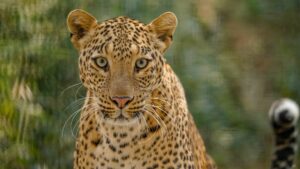
The habitat is shared with another species that, like sloth bears, depends on caves for shelter, the elusive leopard. Leopards and sloth bears are both crepuscular beings. This means that both of them are active during dawn and dusk. Hence, to understand what actually takes place in and around these dens, our team set up cameras around that acted like tiny patient observers capturing nearly a thousand moments of bears padding in and out of caves, many of which surprised even seasoned wildlife researchers.

The cameras revealed something beautifully simple. Sloth bears live by the sun.
Most single bears returned to their den homes just after sunrise, between 5:00 and 7:59 AM. So did bear mother and cubs, with 83% of them entering within that same window. And when the heat mellowed, and the light softened, they would step out again around sunset. In summer, the entire family came home earlier, perhaps trying to outrun the blistering heat or avoid early human activity. What struck the team most was this rhythm, this quiet promise the bears kept each day, every season: back before the sun grew harsh, out again when the light dims.
Most dens weren’t permanent homes. Bears might use a cave for a day and then move on. Families, too, drifted from den to den until the cubs reached a particular age. Between the age of three and nine months, the cubs and their mothers would stay for longer, sometimes 9, 11, or even 18 days at a stretch. During this time, cubs still rode on their mother’s fluffy back, being completely dependent on her. These prolonged stays seemed to be moments of safety and bonding before another journey across the hills would take place. But one young male rewrote the rulebook entirely. After parting ways with his mother, he used the same den for five straight months. It was his small sanctuary, a place he wasn’t ready to leave. For a species known for its constant roaming, this was an extraordinary discovery.

Among the hills of Ramnagara, two bear families were telling a story that unfolded over the years: KB1 and KB8, known within the study as the Kenju and JJ families, respectively. The KB1 or Kenju family’s tale reads almost like a wildlife chronicle. In 2014, she had two cubs. Only one survived, a young male named KB4. When she left the den, KB4 was seen returning to it again and again. In 2016, KB1 gave birth again. One cub survived, KB7, another male who also visited the same den months later. These caves were more than structures for the offspring. They were treated like family heirlooms, silent witnesses to births, departures, and reunions.
KB8 lived in a den that was just 1.75 km away from KB1. Their paths never crossed inside their caves, but the families often used each other’s dens during the same season. They always made sure they were never together in the same cave on the same day. While they never met, the presence of each other was perhaps very well known. It was almost like an unspoken and understood agreement to give each other safe spaces in the crucial stage of their cubs’ lives.
The cameras didn’t just capture patterns. They caught raw moments of sloth bear life. A mother sprinting into a cave with two cubs as a subadult male approached. A tender face-to-face between a mother and a curious young female. A subadult chasing away a larger male, courage outweighing size. It was also revealed that male bears scrape the ground with their feet while defecating, a mysterious behaviour the team calls pede marking, possibly used to signal ownership or presence.

Between these episodes, something unexpected appeared. Porcupines. Lots of them.
Some dens saw porcupines occupying them when bears were also present in them. One camera in a cave had 23% of its recorded photos filled with quills and whiskers. In the Decaan Plateau, both sloth bears and leopards use caves and dens for shelter, but direct encounter is rare. Leopards passed through dens, though never on the same day as bears — sloth bears are physically stronger, so leopards tend to avoid confronting them. This proves that caves were never private territories. They were bustling, rotating shelters shared by species that rarely meet peacefully in the open forest. There was a broader web of coexistence being followed, as the cameras also captured in them rusty-spotted cats, jungle cats and even bats that hung from the ceilings of the caves.
Many sloth bears don’t have the luxury of caves. In places like Mudumalai Wildlife Sanctuary and Nepal’s Royal Chitwan National Park, pregnant mothers dig out dens in dry riverbanks, fragile holes that are often filled when water floods them. These dens are abandoned once the family moves on. In Nepal, sloth bears face another challenge, conflict with tigers. This drives them to adopt behaviour to escape threat — mother sloth bears and her cubs remain active during daytime hours to avoid the nocturnal predator. But eastern Karnataka is different. Its granite hills protect generations: caves give mothers a safe place to nurse; dens shield cubs from heat, predators, and humans. Take away these caves, and you take away the one place where sloth bears can rest, be truly wild, truly themselves.

The Wildlife SOS team’s work doesn’t just map caves. It reveals a secret life of sloth bears that is woven between a habitat of rocks. These are quiet stories of mothers, cubs, wanderers, and survivors. Most of us will never see a sloth bear slipping into a den at dawn. We won’t witness a cub peeking out from behind a boulder. We won’t hear the soft thud of paws on granite at dusk. But now, we know these moments exist. And knowing is the first step toward protecting them. Because in the dark, cool chambers of Karnataka’s ancient hills, the future of the sloth bear is curled up safely, hoping for the world outside to let it be that way.
Wildlife SOS has been studying sloth bears and their denning habits to protect their habitats in the wild. If you wish to support our efforts, please consider making a donation.
Feature image: Akash Dolas/ Wildlife SOS