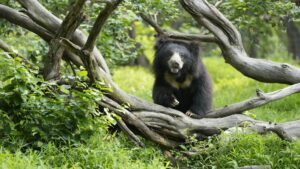
The Science Behind Sloth Bear Home Ranges
Every animal needs enough space to find food, water, shelter, and raise the next generation. For sloth bears, understanding how they use that landscape is one of the keys to protecting them in an increasingly crowded world.
To help explain why this research is so important, we asked Thomas Sharp, Director of Conservation and Research, Wildlife SOS, to answer some of the most common questions about sloth bear home ranges and what they reveal about the lives of these remarkable bears.
Q: How large is a typical sloth bear’s home range, and what factors determine its size?
It depends on the individual bear and where it lives, but for bears, sloth bears have relatively small home ranges. In Nepal’s Royal Chitwan National Park, females average roughly 9 km² and males roughly 14 km². However, in Sri Lanka, sloth bears have some of the smallest home ranges ever recorded for any bear species, with females averaging roughly 2 km² and males between 4 km².
On the Deccan Plateau in southern India, where Wildlife SOS conducts much of its research, the picture is very different. Females average about 16 km², while males average more than 100 km².
Much of this variation is influenced by the habitat type as well as food and water availability, although researchers are still working to understand all of the factors involved. Similar differences occur in other bear species, including brown bears and American black bears, whose home ranges can vary enormously depending on where they live.
Q: Do home ranges differ between male and female sloth bears, or in different parts of India and other countries where sloth bears are found?
Yes. Male bears, of all species, generally have larger home ranges than females. Sloth bears are no exception. Male sloth bears generally have much larger home ranges than females, ranging from about two to ten times larger, depending on the location.
Our research on the Deccan Plateau was the first to document males with home ranges nearly ten times larger than some females. While we know this pattern exists, we are still studying exactly why.

Q: Why is it so important for scientists to understand a sloth bear’s home range?
Understanding how much space sloth bears need to survive is essential for conserving the species. It helps us determine how much habitat should ideally be protected and identifies the areas bears are likely to use outside protected forests.
This information also helps Wildlife SOS identify places where bears and people are most likely to come into contact, allowing us to work with local communities to reduce conflict and promote coexistence.
Q: How do researchers determine a sloth bear’s home range? What technology is used?
Researchers determine a bear’s home range by fitting it with a tracking collar. Earlier studies relied on VHF radio collars, which required researchers to locate bears in the field. Today, GPS collars automatically record a bear’s location, allowing researchers to collect far more detailed movement data with much less fieldwork.

Q: The maps included with this article show the locations of a sloth bear over time. To most of us, they look like a collection of dots on a map. As a biologist, what do you see? What patterns do you look for, and what can they tell you about how that bear lives?
The first thing I notice is where the dots are most concentrated because those areas show where the bear spends most of its time.
By separating the data by season, we can also see whether those high-use areas change throughout the year. I also pay close attention to isolated points that appear away from the main clusters. These outlier locations may indicate exploratory movements into new areas.

Q: How does understanding home ranges help Wildlife SOS reduce conflict between people and sloth bears?
When we find areas where bear activity overlaps with villages or other places where people live and work, we investigate what is attracting the bears. It might be a reliable food source, water, or another resource.
Once we understand why bears are using that area, we can often recommend changes that reduce the likelihood of encounters between people and bears, helping both coexist more safely.
Q: What happens when a sloth bear’s home range is fragmented by roads, agriculture, or development?
Roads can have a significant impact on bear movements. Some species, including brown bears and American black bears, appear to use roads as the edge of their home range, possibly because they avoid crossing them. Unfortunately, roads can also cause direct mortality when bears do attempt to cross.
Agriculture has a more complex effect. While habitat loss is a major concern, sloth bears are also attracted to some crops as a food source. This can bring them into closer contact with people and expose them to human-related dangers, otherwise known as anthropogenic threats, such as snares, open wells, and vehicle collisions.
Q: How do you hope the research Wildlife SOS is conducting on sloth bear home ranges will help conserve the species in the future?
The research being conducted by Wildlife SOS on the Deccan Plateau is helping us better understand how sloth bears survive in this landscape. It tells us how much space they need, how far they travel, and how their movements change throughout the seasons.
The more we understand about their habitat requirements and the factors that lead to human-bear conflict, the better equipped we are to protect sloth bears and conserve the landscapes they depend on.

As sloth bear habitats continue to shrink and encounters between people and wildlife become more common, understanding how these remarkable bears use the landscape has never been more important. Thanks to the generosity of Wildlife SOS supporters, our research team is helping develop practical conservation solutions that protect sloth bears while making it easier for people and wildlife to safely share the same landscape. Every new discovery brings us one step closer to a future where both can thrive together.
Donate now to protect the sloth bears and their habitat.
Feature image: Wildlife SOS