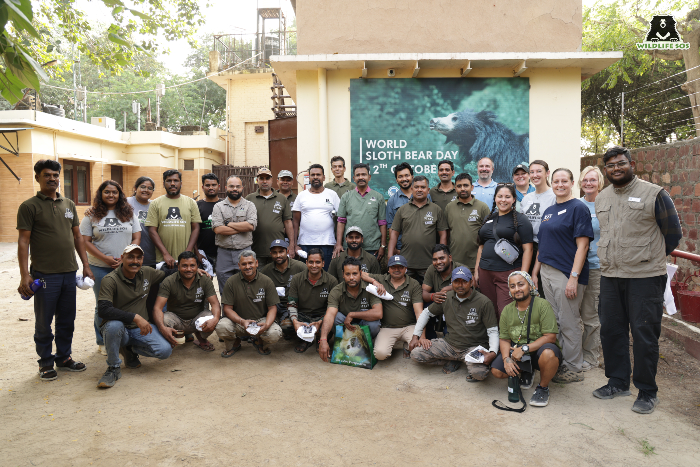
Wildlife SOS welcomed the Bear SAFE team for their third visit to Wildlife SOS bear centres from October 27th to November 5th 2025. This time, the team reached the Agra Bear Rescue Centre (ABRF) to conduct their second workshop here after an enriching experience in 2024. Once again, the event brought together caregivers, veterinarians, behavioural specialists from various U.S. zoos, and of course, our rescued sloth bears, for another deep exchange of knowledge.
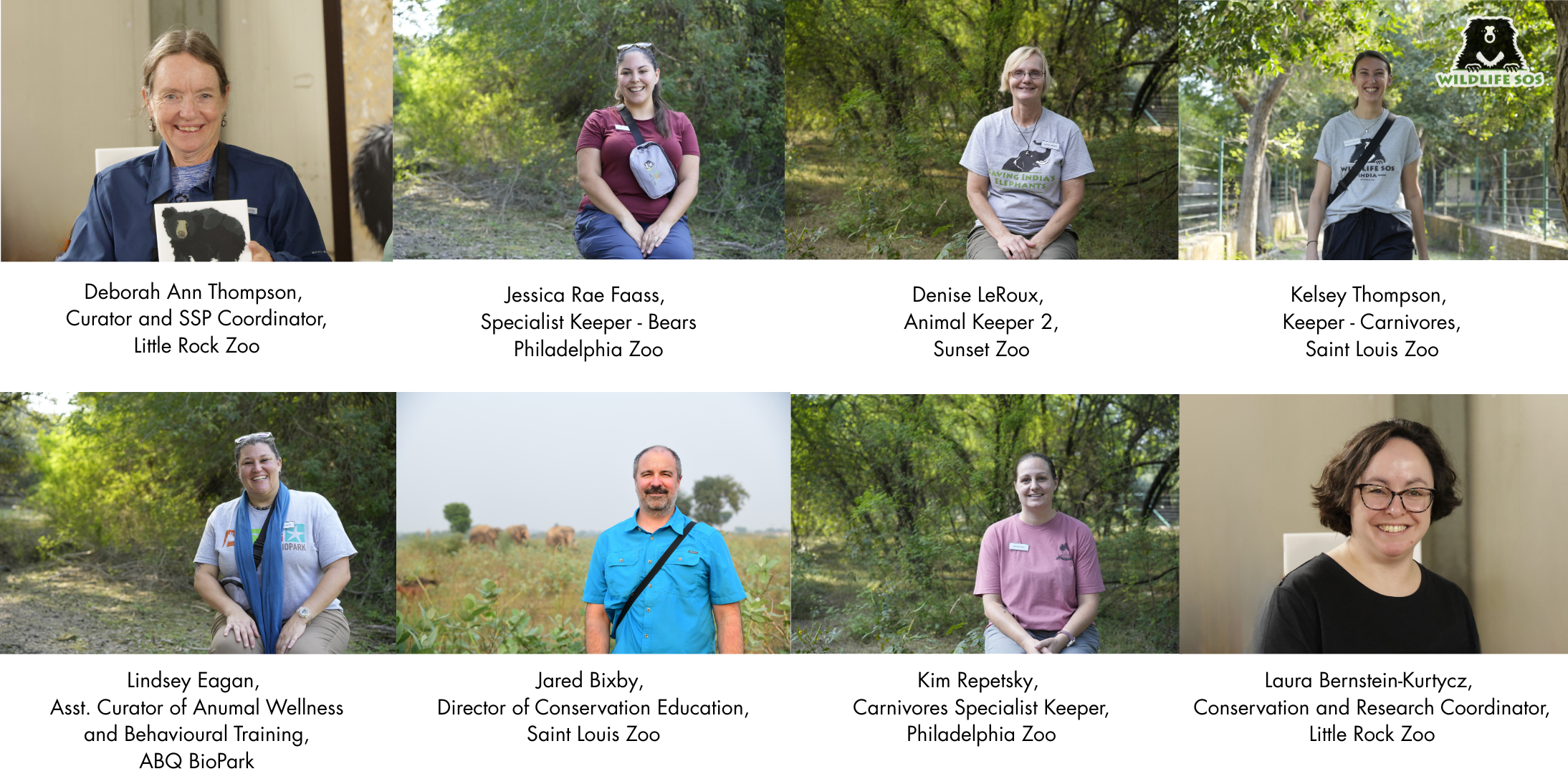
The focus was clear: strengthening positive-reinforcement training, refining medical behaviours, sharpening cues, and creating safer, calmer ways for our bears to participate in their own healthcare. What unfolded was a rewarding blend of learning, breakthroughs, gentle challenges, and fascinating, unexpected moments that remind us just how intelligent, sensitive, and wonderfully individualistic sloth bears are.
Orientation, Introductions and Foundational Behaviours
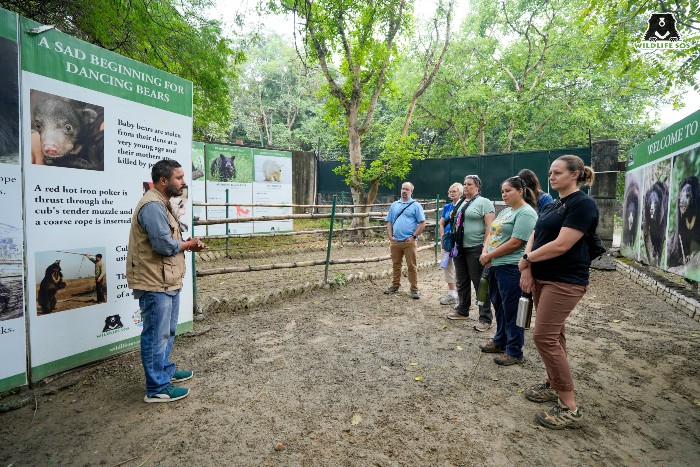
The workshop began with a tour of the centre and the veterinary hospital, followed by an insightful presentation that introduced the visiting U.S. team to the broader conservation landscape in India, especially the challenges and progress around sloth bear welfare in the wild as well as in captivity.
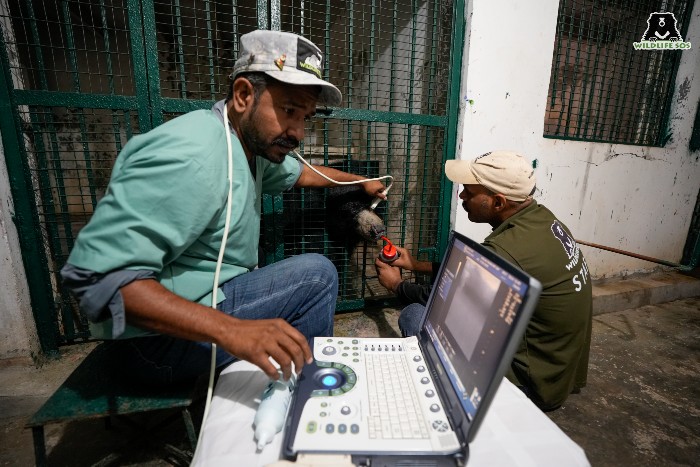
From there, the group headed to meet Molly, our star patient of the day, for a demonstration of all the behavioural cues we would be working on. Since many of our bears already knew a range of behaviours, like sit, sleeve and open mouth from earlier training cycles, this workshop focused on transitioning them from target stick guidance to verbal and visual-based cues. This shift promises to be helpful in streamlining veterinary procedures, ensuring that bears respond calmly and confidently.
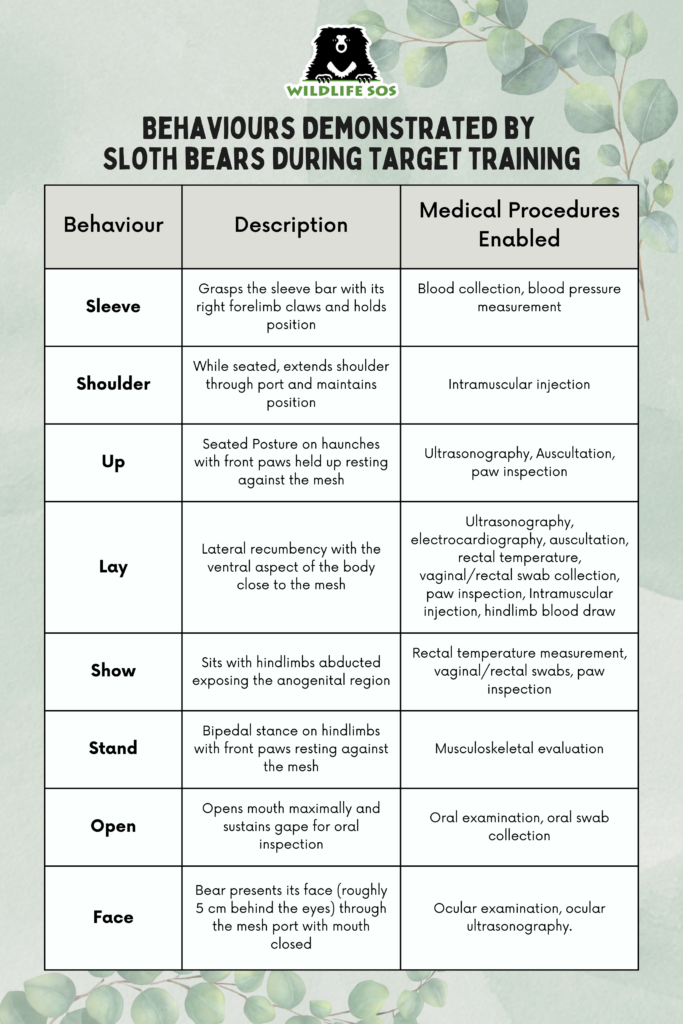
Below is a quick look at the key behaviours demonstrated, and the medical procedures each behaviour supports:
With the groundwork set on Day 1, the team was ready to meet the bears and begin work inside the enclosures, such as fine-tuning cues, strengthening trust, and slowly shifting the bears toward clearer verbal and non-verbal (gesture) based communication.
To make the sessions more focused and effective, the Bear SAFE trainers and Wildlife SOS staff were divided into two groups — Team Momo and Team Kanmani, named after two resident sloth bears at ABRF. Each team was assigned specific enclosures and a thoughtfully curated list of bears to train.
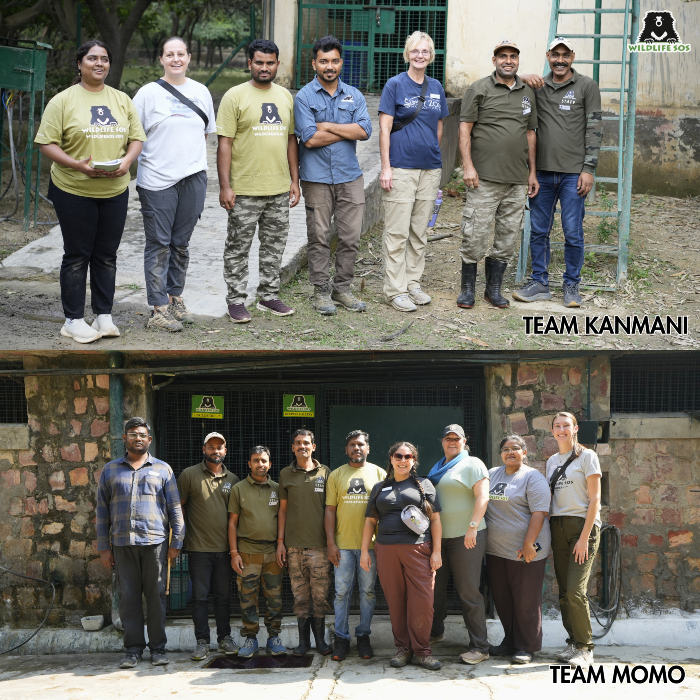
This thoughtful division ensured that every enclosure, and every caregiver, received dedicated time, attention, and personalised guidance. It also allowed the teams to gain a deeper understanding of each bear by observing nuances in behaviour and adjusting techniques accordingly. This made sure no individual was given rushed attention or was overlooked.
Building Trust, Not Just Behaviours
What truly defined the workshop wasn’t the technical training itself, it was the relationships built along the way. Not only between caregivers and their bears, but also between the Bear SAFE team and Wildlife SOS staff. Each bear had their own response to interactions: some were curious, some cautious, some wonderfully dramatic. It was a reminder that operant conditioning is not just about reaching a level of accuracy, it’s about trust, emotional comfort, and creating safe spaces where bears choose to participate.
For many of our caregivers, who have worked to care for the same bears for years, having the SAFE team observe and gently refine techniques brought fresh insight. Sometimes all it took was a slight change in body posture, a longer pause between cues, or breaking one complex behaviour into smaller steps. These subtle shifts made sessions calmer and more effective for everyone involved.
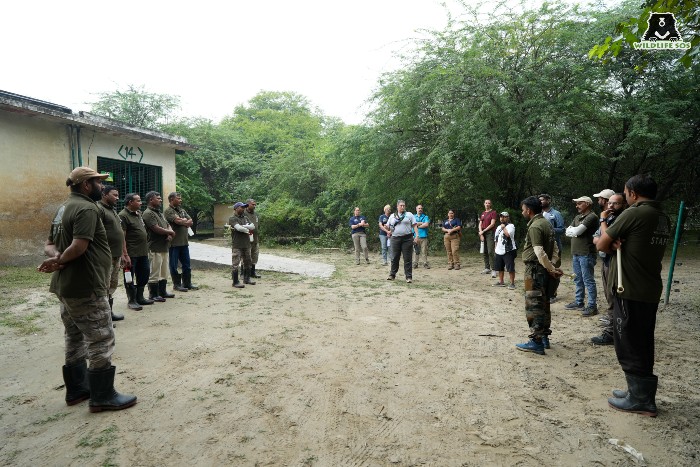
In between all the technical learning were joyful cross-cultural exchanges, shared stories and warm-hearted episodes that strengthened bonds between teams across continents. While our staff learned to fine-tune their training cues, the U.S. team absorbed decades of behavioural knowledge shaped by rescuing and rehabilitating sloth bears at scale.
Shifting from Targets to Audio Cues
A major focus of this visit was helping the bears gradually transition from visual target sticks to audio cues and eventually gesture-based cues. While many of our sloth bears are already confident with the target training process, this shift makes medical procedures smoother, clearer, and far less stressful for them.
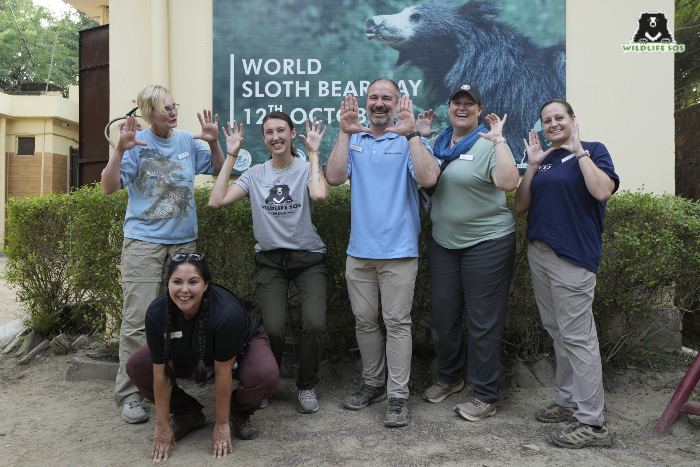
Fewer tools mean fewer distractions, especially during important health checks where calm cooperation is essential. With consistent, well-timed vocal cues, the bears can understand what’s being asked of them instantly, allowing procedures like blood draws, ultrasounds, paw inspections, and oral examinations to happen with minimal stress for both the bear and caregiver.
Some bears took to this transition effortlessly. Younger individuals like Molly and Ron welcomed the new cues with enthusiasm, as long as the train of treats kept rolling! A few of our middle-aged bears surprised the team as well: Suri and Kamli, both 18, were quick learners. Suri picked up “show” (seated position with all four paws against the mesh and body close to the barrier) within minutes, and when Kamli responded to “face”, she presented hers appropriately in the very first go, inviting soft claps and excited grins from everyone around the dens!
Collaborative Problem-Solving and Individualised Training
Older bears like Rangeela (26) required more patience. His enthusiasm was clear, but weaker hind legs made cues like “stand” uncomfortable. The team adapted his training to focus on “lay”, an easier position that still allowed for thorough medical checks.
Valmiki, who struggles with arthritis, found the “lay” cue difficult, so his sessions were adjusted to “show” and “side”, which suited his comfort and medical needs far better.
Sona (22), who is wary of unfamiliar people, was another special case. Her sessions were kept small and controlled, with only familiar caregivers present. Eventually, even after tolerating new people in small groups, she stubbornly refused to respond to most cues given. It was only when her favourite caregiver stepped in to take centre stage that she flawlessly executed them.
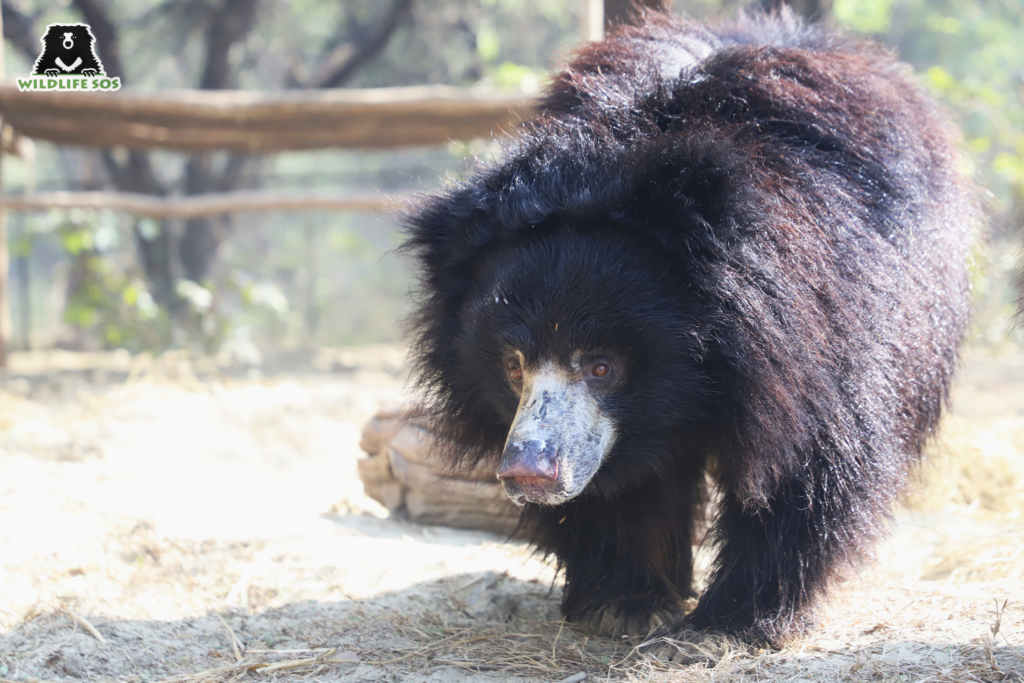
Momo (27) won the award for comic acts. His enthusiasm occasionally led to broken target sticks, misplaced paws, and a perfectly timed fart that sent the whole team into laughter. But by the final day of these sessions, he mastered the “lay” position beautifully, and the celebration was unanimous.
Arifa (25) reminded us just how important individual adaptation is. With a cataract in her left eye, she struggled to recognise left-handed cues. Once the team shifted gestures to her right side and paired them with verbal cues, she responded immediately and confidently.
Understanding the Bears Beyond the Behaviour
Winter weather brought its own challenges. Sloth bears don’t hibernate like other bear species. Rather, they slow down during cold, gloomy days. Sona, after a large breakfast and dull weather, took her time to respond — and on such days, rather than push difficult behaviours, the team kept sessions light, revisiting familiar cues and ending early with plenty of treats.
Some sessions were emotionally heavier, especially with bears like Taj, a former ‘dancing’ bear who endured years of abuse. While she has made remarkable progress over time, sudden hand movements or raised voices, especially from unfamiliar faces, could still trigger a traumatic response. Working with her required slow, measured gestures and soft tones, a powerful reminder of the cruelty these animals once survived, and how carefully their trust must be earned and sustained.
The Joy (and Humour) Behind-the-Scenes
There were, of course, more than many moments that had everyone highly amused — the bear who calmly reset herself to the starting position in the middle of a session, clearly because there were now more chapters added to her cue-book (one she is well versed with), or the enthusiastic overachiever who confidently performed “lay” before the cue was even given, purely by guessing from the trainer’s posture. Then there were those individuals who treated their honey bottle like the only thrilling object around, requiring caregivers to either tuck it behind their backs or switch to low-value treats like dates or jaggery to keep their focus on the behavioural shaping instead of the bribe!
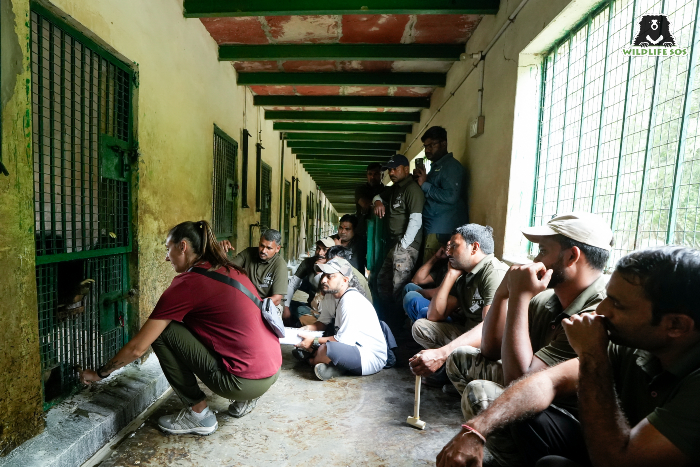
Such episodes grounded the entire week. They reminded us that training isn’t just a tool or mechanism, it involves communication, problem-solving, and remarkable revelations of bear personalities. Through interactive activities, bears get their space to think and express themselves, teaching us how to let them participate on their own terms.
During the workshop, our caregivers also got a day dedicated to enrichments — a chance to put their creativity and understanding of bear behaviour to the test. Split into four teams, they set out to design innovative, challenging, and enriching activities for the bears. From fresh versions of puzzle feeders to scent-based explorations, each team brought something unique to the table. The friendly competition added a spark of excitement, and by the end of the day, everyone walked away with fresh ideas and a renewed sense of pride in the work they have committed themselves to do.
A Taste of India’s Heritage
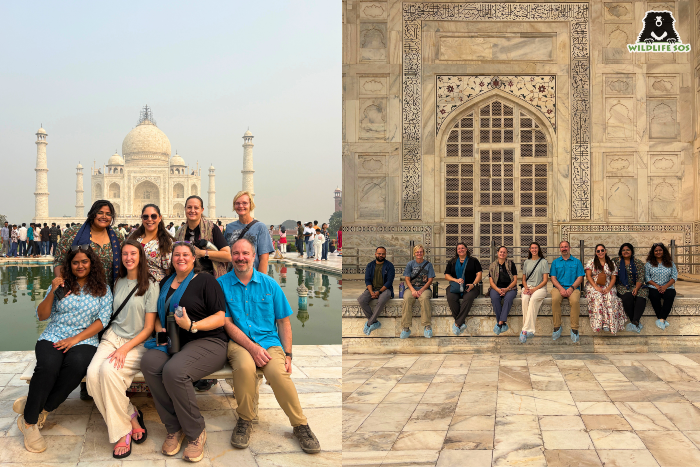
The Bear SAFE team’s visit was profoundly educational, but any trip to Uttar Pradesh is incomplete without witnessing its breathtaking heritage site — the Taj Mahal. Witnessing the historic monument and its architectural beauty undoubtedly left our visitors awestruck.
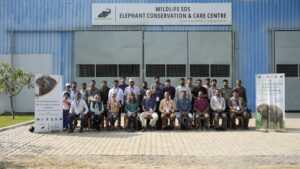
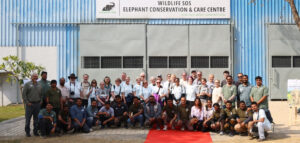
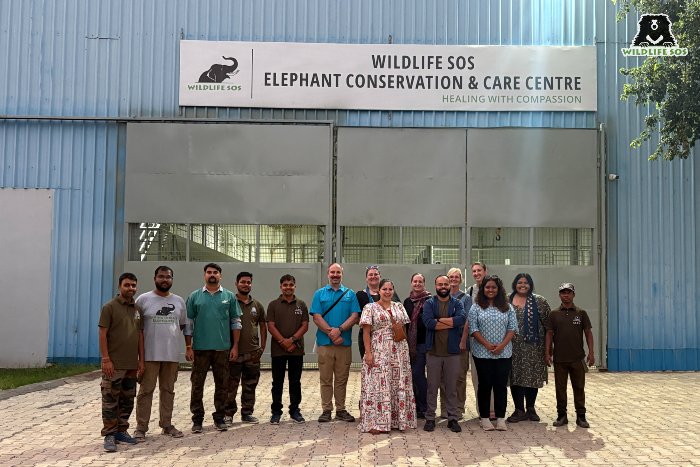
They also spent time at the Elephant Conservation and Care Centre and the Elephant Hospital Campus, learning about Wildlife SOS’s broader conservation work.
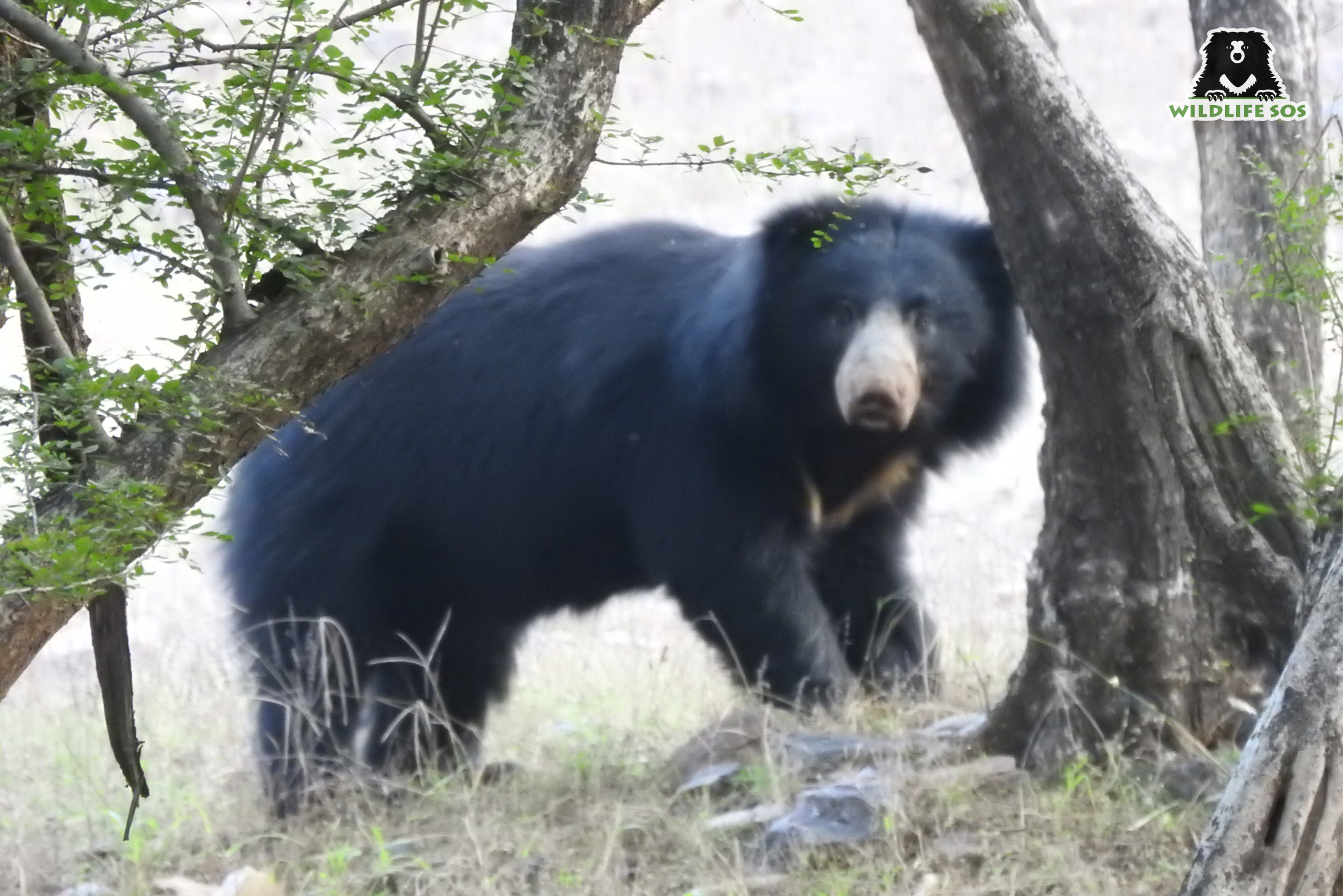
At the end of the workshop, the group visited the Ranthambore Tiger Reserve in Rajasthan. While the elusive tigers kept their distance, the team was rewarded instead with a rare and beautiful sighting — a wild sloth bear. After two weeks with rescued individuals, witnessing their wild counterparts was a meaningful and poetic end to the journey.
What The Week Really Meant
Across Team Momo and Team Kanmani, we worked with over 30 bears:
Some learned new behaviours.
Some refined old ones.
All taught us lessons in patience, timing, empathy, and humility.
Words were shared for all by one:
“Your aura matters. Training changes you first – the bears just follow.”
Two weeks of experiencing quiet breakthroughs, tired arms, sticky honey bottles, and very clever bears…that felt absolutely true.
Join our mission to protect and save wildlife by becoming a monthly donor for Wildlife SOS. Your commitment can help us sustain the welfare of sloth bears residing at our centres.
Feature image: Mradul Pathak