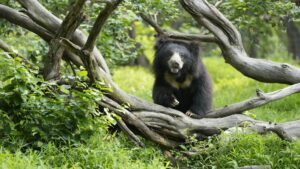
There is nothing as unfortunate or upsetting than the news of an animal found in distress. But what adds to the emotional turmoil is when the news concerns an abandoned, helpless cub so weak and fragile, unable to move. Our team stationed in Bhopal, Madhya Pradesh received such deplorable information about a female sloth bear cub. Barely five months old, she was found alone, injured and fighting for her life by the forest department from Bandhavgarh Tiger Reserve, Madhya Pradesh.
This reserve is one of India’s most predator-dense forests. With no sign of her mother, the cub was vulnerable to threat. The forest department rescued the cub and provided her with initial care. However, realising that the cub needed specialised medical expertise, the officials turned to Wildlife SOS for providing her long-term care. She was brought to Van Vihar Bear Rescue Facility (VVBRF), inside Van Vihar National Park, where close examinations revealed the severe extent of her injuries.
A Fragile Beginning
The bear cub was unable to walk properly. When the clinical team examined the bear, the cub was found with weight-bearing lameness of the left hindlimb, which means she could not place her foot on the ground without facing acute pain. The radiographic images (X-ray) showed a hairline fracture in the upper part of her thigh bone, and another one in her hip socket head. If left unaddressed, the severity of her medical condition was significant enough to compromise the body’s natural structure. There were abrasions found on the foot pad, likely due to painful dragging of her leg to carry her body.
The veterinarians came to understand that the fractures were likely caused after a fall, perhaps in an attempt of climbing a tree to follow her mother or find safety. Her survival in this deplorable condition is itself a testament to her spirit.

Along with bone damage, the overlying soft tissue was critically injured too. On her back left paw, the fourth toe had lost its nail, and the foot pad was deeply ulcerated. This was not just a surface wound. It suggested that she had dragged the injured leg, possibly for days, as she moved through the forest.
In collaboration with our long-time partners, International Animal Rescue (IAR), we named the brave cub Luna as a tribute to the strength she showed through her darkest days. For years, IAR has stood alongside Wildlife SOS, playing an invaluable role in helping us rescue, rehabilitate, and care for countless bears like Luna.

Beyond visible injuries, the team noted that Luna was dehydrated, anaemic, and profoundly underweight for her age — signs of prolonged stress and inadequate nutrition. The treatment plan for her by our team at VVBRF therefore was strategic, consisting of three main focal points. First, special heat therapy was given twice daily to help her bones heal. The second aspect dealt with cleaning and dressing her wound carefully three times a day to prevent infection and help the tissue repair. And third, providing her with needed nutrition as her body healed.
Young bears have a powerful ability to recover, but it takes time and patience. The team believed Luna could regain the ability to move using the very limb that is injured. But that recovery would require weeks and months of dedicated care.
Crucial First Days
Luna underwent a 20-day quarantine period upon arrival at VVBRF, a standard protocol for any newly rescued animal. This is the time when our veterinarians assess health status, monitor for infectious disease, and allow the cub to acclimatise to the space and care around them. The team prioritises stabilisation over intervention, which means no procedures are rushed. In Luna’s case, radiographic examinations — including X-rays and ultrasound — were conducted once she had settled down well in her surroundings.
Initially, Luna would shy away from people of our team by retreating to corners of her indoor enclosure. She was in acute distress, and staff members understood this and gave her time and space to heal.

During this time, Luna began to respond to the compassion of her caregiver. Each time he arrived, the young sloth bear would catch the scent of something he was carrying with him that was simply irresistible, honey. He would offer honey to Luna in a bottle, making her understand his affectionate gesture.

In addition to earlier findings, blood tests showed elevated total leukocyte counts, indicating the immune system actively fighting against infection and trauma. Other parameters reflected the metabolic stress of prolonged malnutrition and injury.
Yet there were also strong signs of recovery, already underway. Her haemoglobin levels were acceptable, her blood glucose was stable. She had gained weight, from 9 kg at rescue to approximately 11 kg by mid-June, a modest but meaningful increase that indicated her body was beginning to respond to proper nutrition.
Nutritious Diet for the Cub
Luna’s intake is designed to provide the nutritional foundation which is critical for her recovery. She has a good appetite and eats well, a positive indicator of her overall recovery trajectory. Her diet is carefully composed to accommodate her young age and health condition.
Sloth bear cubs remain entirely dependent on their mother for at least the first two years of their life. The mother provides them with sufficient nutrition through her milk during the first few months. Like all cubs under our rehabilitative care, Luna receives a specialised milk formula mimicking a mother’s which has elements such as protein and fat essential for a growing cub. Fresh fruits supplement her diet, supporting her appetite and recovery.

Signs of Healing
Luna has begun revealing her playful nature, by willingly engaging in enrichments created specially for her.
Even with her ailments, she energetically attempts to explore them, especially because caregivers have spread dollops of honey all over them! These significantly indicate that beneath the physical injury and mental trauma, her natural drive of being inquisitive persists.

What Luna’s Rescue Means
The rescue and care of Luna represents the significance of critical veterinary knowledge needed for wildlife rehabilitation and the sensitive attention that young animals with severe injuries require to give them a genuine chance at recovery.

The path ahead remains long. Bone healing, particularly in young animals, typically requires weeks to months. The wound on her paw must be managed to prevent infection and allow tissue repair. And her physiological functions must gradually improve as the healing process advances.
But for the first time since her injury, Luna is not fighting alone in a forest where survival is measured in hours. She is receiving special care and attention by the expert veterinarians with consistency and patience.
Support Luna’s Recovery
The treatment and rehabilitation of orphaned wildlife requires dedicated resources, expert care, and sustained commitment. You can also support brave Luna by sponsoring her care. By doing so, you will be contributing towards her medical treatments, nutrition, and all the honey that she desires!
Feature Image: Mradul Pathak/ Wildlife SOS