
As winter eased off across parts of India, February offered a revealing snapshot of the evolving relationship between people and wildlife. Across urban spaces, agricultural landscapes and colder northern terrains, Wildlife SOS’s Rapid Response Units responded to animals navigating spaces increasingly shaped by human activity.
From reptiles seeking refuge in concrete environments to birds and mammals struggling with injury, displacement or seasonal stress, each rescue this month highlighted a larger ecological pattern. Teams across Delhi-NCR, Uttar Pradesh, Gujarat and Jammu & Kashmir worked in coordination with local communities to ensure that any animal in distress received timely care, rehabilitation and, wherever possible, a safe return to the wild.
Delhi-NCR
In the bustling industrial locality of Mayapuri in Delhi, an unusual sight caught the attention of residents when an Indian flapshell turtle was spotted struggling inside a sewage canal. Recognising the urgency of the situation, a local resident reached out to the Wildlife SOS emergency helpline.
The rescue team carefully navigated the confined canal space and secured the turtle without causing additional stress. Fortunately, the animal showed no visible injuries and was stabilised shortly after the rescue.
Following due protocol, the turtle was transferred to the Asola-Bhatti Wildlife Sanctuary, where it underwent observation before being released into a suitable habitat.
The Indian flapshell turtle (Lissemys punctata) plays a crucial ecological role as a scavenger, helping maintain the health of aquatic ecosystems. However, increasing water pollution and habitat disruption are steadily pushing such species into unsafe, human-dominated spaces.

In February alone, the Wildlife SOS Rapid Response Unit in Delhi-NCR carried out 131 rescues, including 18 reptiles, 77 birds and 36 mammals. Many of these cases involved animals navigating urban infrastructure, a growing trend linked to habitat destruction and changing movement patterns.
Agra, Uttar Pradesh
A very different yet equally telling situation emerged in Nekpur village, Agra, where a temple construction site became an unintended refuge for seven Indian rat snakes. Hidden within a pile of bricks, the snakes had likely sought shelter in the dark, undisturbed space, which is a common behaviour for reptiles.
When workers noticed movement within the structure, they alerted the Wildlife SOS team. Rescuers carefully extracted all seven snakes, ensuring the safety of both the animals and the people present.
After a brief period of observation, the snakes were released back into their natural habitat.
The Indian rat snake (Ptyas mucosa) is a non-venomous species that plays a vital role in controlling rodent populations. Yet, due to frequent misidentification as cobras, they are often killed out of fear, making rapid response interventions critical.

During February 2026, the Agra team responded to 77 distress calls involving 22 reptiles, 34 mammals and 21 birds.
Incidents of finding wild animals in cities that are expanding at a fast pace reflect how human occupied areas are increasingly overlapping with wildlife habitats, creating risks of conflict.
Vadodara, Gujarat
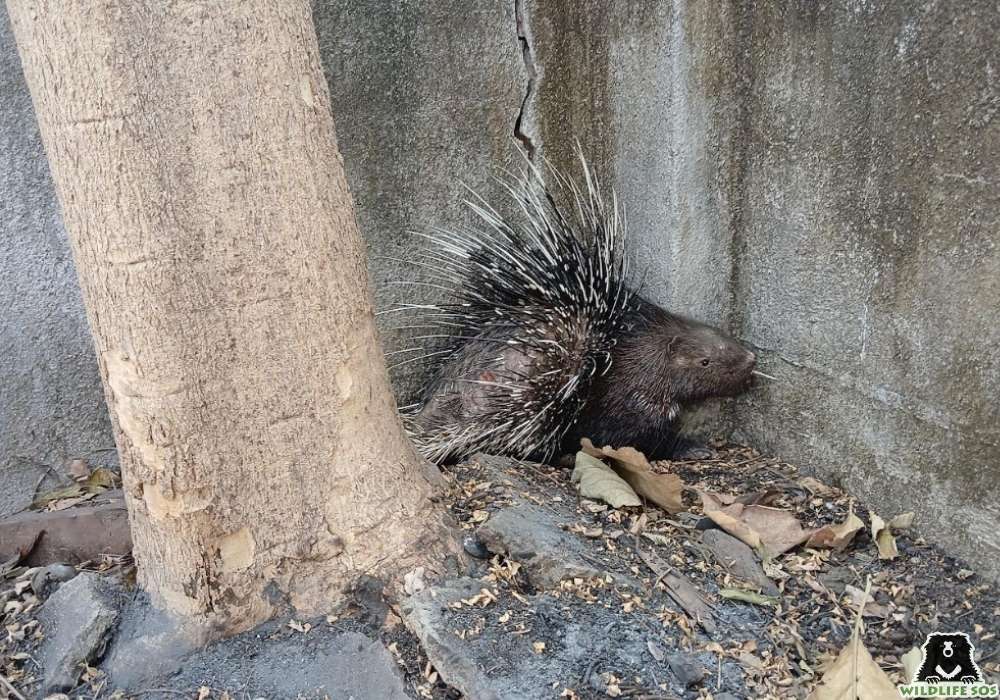
In Vadodara, the movement of wildlife across natural corridors became evident when a porcupine entered a residential society on Vishwamitri Road after crossing a nearby river, likely in search of food.
While such movement is not unusual, it often leads to conflict when animals enter densely populated areas. Residents, unsure of how to respond, contacted professionals at Wildlife SOS, a crucial step in preventing panic-driven reactions.
The Wildlife SOS rescue team in collaboration with the Gujarat Society for Prevention of Cruelty to Animals (GSPCA) assessed the situation and safely secured the animal using specialised equipment. The porcupine was transported to the rescue facility, examined, and released the following day after being declared fit.
The Vadodara unit handled a wide spectrum of cases this month that included 15 mammals, 50 birds and 18 reptiles, taking the total number of rescues made to 83.
Such diversity in rescue cases highlights the ecological richness of the region that is being impacted as wildlife navigates fragmented habitats.
Jammu & Kashmir
In Jammu & Kashmir, the winter season sets a different scenario for wildlife. With harsh temperatures and limited food availability, animal activity slows down. However, the cases that do emerge are often linked to survival stress.
One such instance involving an owl family of three was reported by local residents. When located, one of the three had unfortunately succumbed to starvation, while the other two were found to be extremely weak, likely due to difficulty in finding food. The rescue team, determined to provide immediate aid to the other two, swiftly brought them to the Dachigam Rescue Centre, where they were provided nourishment and care.
Once the remaining owls regained strength, they were successfully released back into the wild.
Along with the two owls, the Jammu & Kashmir Rapid Response Unit also rescued three kites during February, saving five avian lives in all.
Each rescue this month is a reflection of the critical role played by timely human intervention and community awareness in protecting wildlife. As human populations expand and natural habitats shrink, such interactions are becoming inevitable, hence making it all the more important to respond with care, sensitivity and the right knowledge.
If you encounter an animal in distress, you can contact the Wildlife SOS emergency helpline:
Delhi-NCR: +91-9871963535
Agra, Uttar Pradesh: +91-9917109666
Vadodara, Gujarat: +91-9825011117
Jammu & Kashmir: +91-7006692300
Your call can help save a life.

Feature Image: Kunal Malhotra/ Wildlife SOS