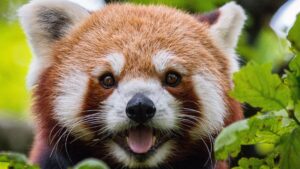
Wildlife SOS’s series “Things You Didn’t Know About” explores fascinating and lesser-known facts about various species. Our writers spotlight one inhabitant of the wild, unveiling its unique characteristics and roles in the ecosystem. In this article, we turn our attention to a creature often found lounging on tall tree branches and vocalises with a huff-quack sound that makes them sound like ducks — the red panda.
Whenever we hear the word “panda”, one image almost instantly comes to mind: a big, black-and-white bear, lazing around and munching on bamboo.
But the name is shared by another, much smaller and rather underrated mammal.
Meet the red panda (Ailurus fulgens) — a species often and mistakenly associated with its famous namesake, the giant panda (Ailuropoda melanoleuca), despite the two being far from related.
High in the dense Himalayan forests, the red panda lounges quietly among the trees. Its soft, wraparound tail doubles as a cushion and a blanket, while its rust-red fur, kitten-like face, and white markings make it a striking animal in the wild. Beneath its fluff are two layers of fur: a soft undercoat covered by longer, coarse hairs that help insulate it against the chill of the mountains.

Same name, different families!
First and foremost, red pandas are not bears. The red panda belongs to its own family, Ailuridae, while the giant panda belongs to the bear family, Ursidae. In fact, with the rest being extinct, red panda is now the only surviving member of its family, and are speculated to be more closely related to animals such as raccoons, skunks, and weasels than to the giant panda. And here’s another twist to the tale: the red panda was scientifically described for the first time in 1825, decades before the giant panda had been in 1869!
So, how did these two animals end up sharing a name?
Interestingly, the word “panda” is believed to have roots in the Nepali word ponya that means a bamboo-eating animal, which is the main intake for both pandas. The “red” in red panda, meanwhile, comes from the reddish-brown colour of their thick fur.
Along with their food preference, both red and giant pandas have also evolved a “false thumb” that is actually an enlarged wrist bone functioning much like an extra digit. This is what helps them grip bamboo and steady themselves as they move through the trees.
Features common to red panda and the giant panda are an example of convergent evolution, a process in which two unrelated species independently develop similar features because they face similar challenges or have similar needs. In this case, two very different pandas evolved a remarkably similar solution to the same challenge: how to get a better grip on bamboo.

There’s more to know about the red panda!
For years, taxonomists examining the red panda features scratched their heads and debated if they belonged to the bear family or that of the raccoons. Bamboo-eaters with remarkable thumbs pushed them to the bears’ side, while its size and the ring-pattern of its tail made them resemble raccoons. Eventually, red pandas rightfully claimed their very own identity, with a genetic test confirming their uniqueness.

Found across parts of India, Nepal, Bhutan, China and Myanmar, red pandas are specially adapted to life in the trees, especially where bamboo density is high. They can be found in the high-altitude Asian forests, growing to a size of about 25 inches, with nearly 20-inch-long bushy tails that keep them warm when temperatures drop. What makes them agile climbers are their claws that have the ability to partially retract so they can clasp the barks. Their long tails also help them balance across the branches as they move. And remember that extra thumb on their wrists? These, along with extraordinary ankles that can rotate, come in handy to maintain the grip they need as they rush up or scurry down, headfirst!

When it comes to their diet, red pandas can consume approximately 2 kg of food in a day, which is somewhere around 30% of their body weight. These mammals may be classified under the order Carnivora, but red pandas are primarily vegetarians feeding on bamboo, fruits and leaves. Their powerful molars help them grind through the tough plant material. And here is a fun fact: given their intake, red pandas produce “green” colour faeces. With all that bamboo going through them, they can poop the equivalent of their body weight in just one week!
Red pandas have a family of their own that comprises two subspecies — the Himalayan red panda (Ailurus fulgens fulgens) and the Chinese red panda (Ailurus styani). However, research is suggesting that these two subspecies might actually be two separate species instead. The scientific discussion around this distinction, however, is still ongoing.
Life Between the Trees
Let’s take a look at the red panda’s daily routine. They are most active around dawn, dusk, and through the night. Around three to four hours after sunrise, they tend to retreat into the trees. It is here where they set aside time to groom themselves, much like how cats are committed to doing each day. This is why they are also nicknamed as red cat-bears. Red pandas use their claws to comb their thick, protective fur. Soon after, they choose their own little resting spot to conserve their energy, using their famously fluffy tail to wrap themselves in.

Endearing mammal, Endangered species
As per the IUCN Red List of Threatened Species, the red panda is classified as Endangered. Despite needing mass attention towards its declining numbers, the red panda still remains the lesser-known one between the two pandas.
This is not unusual in the wildlife conservation field. The concept of “flagship species” refers to animals that are charismatic, recognisable or culturally significant enough to capture public attention and inspire support for conservation. The giant panda’s familiar black-and-white face has become closely associated with wildlife conservation itself.
But being less recognisable does not mean being less important. The red panda happens to be a flagship species in Bhutan, where its presence has helped draw attention to the conservation of its Himalayan habitat and control the growth of bamboo. This shows how awareness can rightly make an animal deeply significant to conservation within its native range.
For a species so closely tied to life in the forest canopy, habitat loss is one of its biggest challenges it is facing today. Deforestation and the fragmentation of forests can reduce the continuous stretches of habitat red pandas need to feed, rest, reproduce, and move between trees. As forests are cleared or broken up by human activity, their once-connected homes are becoming increasingly isolated.
Their distinctive appearance has also made them vulnerable to hunting and illegal wildlife trade. Red pandas have historically been hunted for their fur and tail, which are used to make traditional hats in China and Nepal. They are also being trapped, caged and sold as exotic pets.
The irony is hard to miss: an animal that has evolved so perfectly for a life among the specific trees it needs is now deeply affected when those very trees begin to disappear.
Perhaps that is why looking beyond the most familiar animals for conservation matters. The red panda has a story of its own, one that began with a remarkable animal residing among the Himalayan forest that finally established its identity, to now being the animal severely targeted by human-oriented threats.

Conservation of a species begins with awareness among ourselves, along with legal strongholds that protect the species from illegal trade, and extends to the forests that need to be protected alongside it.
We at Wildlife SOS have witnessed how habitat regeneration efforts can revive not one, but multiple wildlife species to create a healthy ecosystem balance. Under the ‘Rewild for Wildlife’ initiative, we are working to restore and conserve habitats, creating spaces where native species can return, thrive, and continue to belong. In Ramdurga Valley, these efforts have already reawakened a landscape and brought back species that once belonged there.
Support our habitat restoration efforts and help ensure wildlife has a home to return to.
To remain connected with knowledge and awareness concerning wildlife, do subscribe to our newsletter.
Feature Image: Canva