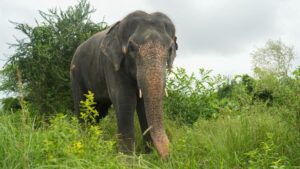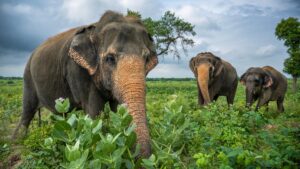
“Animals understand when someone truly cares for them.”
Every rescued elephant’s journey is supported by a team of people who work quietly behind the scenes. It includes planning, observing, coordinating and ensuring that every day unfolds with care. At Wildlife SOS’s Elephant Conservation and Care Centre (ECCC), one such person is Laxman Singh, whose role as the Manager of the centre brings together compassion, responsibility and years of hands-on experience.
Raised near Agra and originally trained in science and education, Laxman’s path into wildlife conservation was not something he had planned from childhood. Yet, looking back, his connection with animals seems to have been present long before he entered the field professionally.

“Some work takes energy. Some work gives it back.” For Laxman, caring for rescued elephants has become both purpose and motivation. [Photo © Wildlife SOS/ Mradul Pathak]
From caring for an injured dog during his school years to overseeing the daily management of rescued elephants today, his journey reflects something simple yet powerful, that meaningful work often begins with empathy.
June 2026 is when Laxman completed a decade with Wildlife SOS. What better time than now to bring his story forward! While conversing with him, Laxman gave us a glimpse into his early life, his journey with Wildlife SOS, what elephants have taught him over the years, and what keeps him motivated every day.
Tell us a little about yourself. Where did you grow up and what was life like during your childhood?
I come from a town near Agra, where I spent most of my childhood and completed my education. Later, I pursued B.Sc. and B.Ed., and before entering wildlife conservation, I also worked in teaching. I belong to a close-knit family and grew up in an environment where education and values were always important.

“You don’t always need touch to build connection, sometimes respect creates the strongest bond.” [Photo © Wildlife SOS/ Mradul Pathak]
At the same time, I have always felt connected to animals. Even before joining Wildlife SOS, I found myself naturally paying attention to animals around me, if their behaviour seemed unusual. Over time, I realised that I could often understand changes in their routine and behaviour simply by observing them closely.
I often feel that understanding animals requires patience. Just as a mother understands her child without words, I believe animals also communicate in ways that become visible when you spend time paying attention to them.
Was there an early memory that made you realise you cared deeply about animals?
Yes, there is one memory that has stayed with me for many years.
During my school days, a dog appeared near my house with a serious injury on its leg. I noticed immediately that it was unable to walk properly and seemed to be in pain. When I looked closely, I realised the wound had become severe and needed attention.
I started treating the dog and continued caring for it regularly. Slowly, it recovered. After that, the dog kept returning to my house and became comfortable around me.

“Animals understand kindness. If you care for them genuinely, they respond in their own way.” [Photo © Wildlife SOS/ Mradul Pathak]
That experience taught me something that I still carry today, that animals understand kindness. If you care for them genuinely and try to understand them, they respond in their own way. That was probably one of the earliest moments when I realised how strongly I felt about helping animals.
How did wildlife conservation became a part of your life, and how did you eventually join Wildlife SOS?
My connection with Wildlife SOS started through familiarity with the rescue work happening in the region. Since I lived relatively close to the Agra Bear Rescue Facility, I had heard about the organisation and knew of the work being done there, although I didn’t fully understand it at the time.
As I learned more, especially about the lives of rescued animals and the challenges they had faced before rehabilitation, I became more interested. I realised that many animals had experienced suffering simply because they were being used for entertainment or other purposes, and I never felt comfortable riding animals or seeing them used commercially.

For Laxman Singh, every day at ECCC begins with a simple belief: caring for animals starts with understanding them. [Photo © Wildlife SOS/ Mradul Pathak]
At that point in life, I was also exploring career opportunities and came across one to join Wildlife SOS. When I joined, I started learning slowly, understanding operations, observing animal behaviour and growing through experience. I joined the organisation in June 2016, and having recently completed 10 years with Wildlife SOS, I feel grateful for how much this journey has taught me. Over time, that journey brought me to where I am today.
Do you remember your first day at Elephant Conservation and Care Centre?
Very clearly!
I remember meeting the team and understanding the philosophy behind the work happening here. I was introduced to the centre, the elephants and the responsibilities involved in caring for rescued animals.
One thing that stayed with me from the beginning was the importance of respect.

From daily planning to unexpected challenges, every decision at ECCC is guided by one goal: ensuring rescued elephants receive the care they deserve. [Photo © Wildlife SOS/ Mradul Pathak]
People often feel affection for elephants and want to interact closely with them, but elephants also need space and understanding. Building trust does not always mean physical interaction. You can create connections simply through patience and respect.
That perspective stayed with me and continues to shape the way I work even today.
As Manager at ECCC, what does a typical day look like for you?
Every day begins with planning, but every day also brings something unexpected. My work involves many different responsibilities, from elephant management and feeding routines to enrichment planning, staff coordination, maintenance work and ensuring the centre functions smoothly. There are also construction activities, infrastructure work, monitoring systems and communication that happen throughout the day.

For Laxman, responsibility doesn’t end when the day does, care continues beyond working hours. [Photo © Wildlife SOS/ Mradul Pathak]
At ECCC, there is rarely a fixed routine. Some days involve operational management, while other days require responding to immediate needs and ensuring everything remains on track. It is a role that requires flexibility and attention to detail because every small part contributes to the overall wellbeing of the elephants.
What is something people often don’t realise about caring for elephants?
I think many people don’t realise that care is not only about affection, it is also about understanding and respect. Every elephant has a different history and different experiences. Many rescued elephants have been through situations where they were used or treated in ways they should not have been.
When visitors come to the centre and learn those stories, I believe their perspective changes. People begin to understand why riding, entertainment and certain interactions are harmful. My hope is always that visitors leave with greater awareness and become more thoughtful in the choices they make afterwards.
Have elephants taught you anything unexpected over the years?
Absolutely. Every elephant has a unique personality and there is always something to learn.
One elephant who stands out to me is Laxmi. Watching her responses during daily care reinforced something important, that patience and positive reinforcement are powerful.

Years in conservation have taught Laxman that patience often achieves more than force. [Photo © Wildlife SOS/ Mradul Pathak]
With trust, encouragement and understanding, elephants become more comfortable and cooperative. That lesson applies beyond animal care as well. Sometimes the best way to guide someone is not through pressure, but through patience and motivation.
What motivates you through difficult days?
Challenges are part of every day here. But I believe that difficult situations become manageable when you stay committed to the purpose behind the work.
One thing I strongly believe is that conservation work carries responsibility. Every effort, every resource and every day should be respected.
Interestingly, I rarely feel tired while I am at the centre. Most of the time, the exhaustion comes only after returning home. Once I return the next day and begin working again, the energy comes back.
For me, this work feels connected to the heart.
What does life outside work look like for you?
To be honest, work continues even outside working hours. Even on leave, I remain connected. My phone stays active and I continue monitoring updates and staying in touch with the team.

The stories behind these chains are difficult to hear, but important to tell. By guiding visitors through ECCC, Laxman helps transform curiosity into compassion for rescued elephants. [Photo © Wildlife SOS/ Mradul Pathak]
If there is an emergency or an elephant needs support, I come in. There have been many instances where late-night situations required immediate attention and being available is simply part of the responsibility.
That doesn’t feel difficult, it feels natural when you care deeply about the work.
Has working with elephants changed the way you see life?
Yes, I believe it has. Since joining Wildlife SOS, life has felt smoother and more meaningful in many ways. I feel grateful that I have had the opportunity to work with rescued animals and contribute to something larger than myself.
Being around elephants teaches patience, responsibility and perspective. It reminds you that care and consistency can make a difference.
What does Wildlife SOS mean to you?
Wildlife SOS has given me the opportunity to work closely with animals and contribute to their care in a meaningful way.
I feel fortunate to be part of this journey and to spend my days supporting animals that deserve safety, dignity and a better life.
What message would you like to share with people who want to work in wildlife conservation?
You do not have to start with something big. If you see an animal in need, help where you can. Respect animals, try to understand them and support their wellbeing in whatever way is possible.

From helping an injured dog as a child to caring for rescued elephants today, Laxman Singh’s journey reminds us that compassion can shape a lifetime. [Photo © Wildlife SOS/ Mradul Pathak]
Compassion for wildlife does not depend on the profession you choose. It starts with the thought of choosing to care.
Laxman Singh’s story reflects how meaningful change can begin with something as simple as empathy. Through patience, responsibility and respect for animals, he continues to play an important role in giving rescued elephants the care and dignity they deserve.
For the last 30 years, Wildlife SOS has been dedicated to the rescue, rehabilitation and conservation of India’s vibrant yet threatened wildlife. Visit or volunteer at our centres to witness and be a part of the care given to rescued animals. Write to us at [email protected] for more details. If you’d like to contribute towards our various conservation projects, consider supporting our work.
Feature image: Mradul Pathak/ WIldlife SOS