The gentle chirping of birds, layered like an orchestra with the rustle of trees and the constant rhythm of the sea — this was the world Reegan Pushbanathan grew up in along the coastal belt of Tamil Nadu, igniting his curiosity for nature and wildlife.
Born in Keelmathur near Mayiladuthurai, Tamil Nadu, Reegan’s early connection with nature continues to influence his work as a Field Biologist with Wildlife SOS today. Fluent in Tamil, English, Hindi, and Kannada, he has traversed multiple landscapes in India, adapting to different terrains, communities, and species along the way.

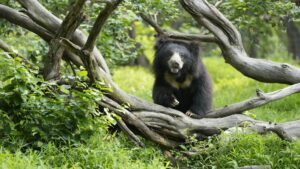
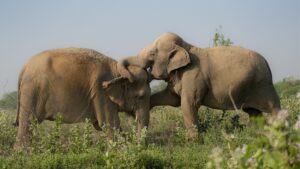
From the forests of Karnataka to the high-altitude terrains of Kashmir, Reegan has contributed to critical research on sloth bears, elephants, and Himalayan brown bears. His work sits at the intersection of science and conservation, where field data directly informs decisions that impact wildlife and the people who share their habitats.
We recently sat with Reegan and got a glimpse of his amazing journey. Let’s dive in!
What sparked your interest in the field of Wildlife Biology?
Growing up in the Tamil Nadu coastal belt near Mayiladuthurai, I was always surrounded by the natural world — birds, insects, forests, and the sea. This early curiosity led me to pursue a B.Sc. Zoology at A.V.C. College (Autonomous), Mannampandal, where I graduated with a First Class and earned a Gold Medal at the college level. This achievement confirmed my deep-seated belief that Biology was not merely a subject for me; it was a lifelong calling. From there, the step to M.Sc. Wildlife Biology felt completely natural.

What drew you to join Wildlife SOS?
When I completed my postgraduate studies, I was looking for an organisation where science directly drove conservation outcomes, not just research for its own sake, but research that made a real difference to animals and communities. Wildlife SOS stood out for this reason.
I joined Wildlife SOS in November 2014, and from the very beginning, the organisation gave me the opportunity to work on challenging and meaningful field projects.

What’s the most rewarding part of your work?
The most rewarding moments come when hard-won field data is translated directly into better protection for wildlife. Over the past 11+ years, I have been part of some genuinely impactful work, including these projects:
1) Radio-collaring four Himalayan brown bears in Kashmir contributed to conflict mitigation strategies in high-altitude human-bear interface zones.
2) Radio-collaring of one female elephant Van Devi in Chhattisgarh, adding critical data to human-elephant conflict early warning systems.
3) Conducting population estimation census across five wildlife sanctuaries–Daroji, Gudekote, Arasikere, Kanker, and Kashmir–that helped establish baselines for sloth bear conservation.
4) Submitting more than 10 detailed scientific and technical reports to forest departments across Karnataka, Chhattisgarh, and Kashmir that directly informed wildlife management decisions.
5) Rescuing more than five sloth bears with a team from conflict situations, giving those animals a second chance.

Seeing a bear I helped radio collar move safely through a landscape, or reading a forest department policy that incorporates our census findings, are moments of deep professional satisfaction for me.
If you could be any animal for a day, which one would you choose?
Without hesitation, I’d love to be a snow leopard. In July–October 2021, I had the privilege of studying their distribution in the Central Wildlife Division of Kashmir, where I worked at high altitudes in some of the most dramatic landscapes on earth. The snow leopard’s ability to move silently through steep Himalayan terrains, cover vast home ranges with seemingly effortless grace, and exist in such a remote and beautiful world has left a deep impression on me.

Apart from your love for work, what are your hobbies?
My hobbies are closely connected to my professional interests. I enjoy reading research papers and books, following the latest literature in wildlife ecology, conservation biology, and behavioural science, while also exploring natural history more broadly. I am constantly learning new data analysis methods and tools, and currently work extensively with R (programming language) for statistical modelling, Python for machine learning applications (including regression, classification, clustering, and PCA – Principal component analysis), Google Earth Engine (GEE) with Java and Python for remote sensing analysis (LULC, NDVI, LST, EVI), and Quantum Geographic Information System (QGIS) for mapping home ranges, movement patterns, and distribution maps. I also find mapping and spatial analysis deeply satisfying, particularly the process of turning field data into well-crafted distribution or density maps that tell a conservation story visually.

What’s the best advice you’ve ever received? And would you like to share any of your own advice for aspiring wildlife researchers?
The best advice I received early in my career was: “Let the data lead you, not your assumptions.” In wildlife fieldwork, it is easy to enter the forest with preconceived ideas about where an animal will be or what it will do. The animals rarely cooperate with these assumptions, and that is actually the most scientifically valuable thing about them.

My advice for aspiring wildlife enthusiasts is as follows:
Be patient and persistent, as field research demands long hours, difficult terrain, and often years before meaningful results emerge, but the rewards are worth it. Building a strong technical toolkit is equally important; modern wildlife biologists are also data scientists, so learning tools like R, Python, QGIS, and remote sensing, alongside field skills such as camera trapping and radio telemetry, is essential. Writing and publishing your work matters too, as data in notebooks alone does not contribute to conservation.

If you could solve one major challenge in wildlife conservation, what would it be?
It has to be human-wildlife conflict. I have spent the most time working on this challenge, from elephant conflict mitigation in Chhattisgarh (2018–2021, including radio-collaring for early warning alert systems) to bear-human conflict in Karnataka and Kashmir, and it remains the most urgent unresolved issue in Indian wildlife conservation.
Conflict costs lives on both sides: people lose crops, livestock, and sometimes their own lives, while animals are killed in retaliation or captured in ways that are traumatic and often fatal. The tragedy is that both sides are victims of a larger systemic failure: shrinking habitats, fragmented landscapes, and development pressures that push wildlife and people into closer and more dangerous contact.

If I could solve one challenge, it would be building scalable, community-owned early warning and coexistence systems combining radio telemetry, remote sensing, and mobile technology to give farmers and forest communities real-time awareness of approaching wildlife, while simultaneously creating genuine economic incentives for communities to see living alongside wildlife as beneficial rather than threatening to their livelihoods.
What’s the biggest challenge as a field biologist?
The biggest challenge is bridging the gap between the volume of data collected and the speed at which the data reaches decision-makers and influences conservation outcomes.
We deployed camera traps that generated thousands of images. We attach radio collars that produce continuous location data for several months. We conduct population censuses that are labour-intensive and yield large datasets. Processing, analysing, and interpreting all of these data rigorously using models such as the Random Encounter Model (REM), Camera Trap Distance Sampling (CT-DS), Spatially Explicit Capture-Recapture (SECR), species occupancy models, and habitat selection analyses takes considerable time.

By the time a technical report reaches a forest department, the conditions on the ground may have shifted. Compressing this cycle to produce analysis and reports faster without compromising scientific rigour is a constant challenge in applied field biology.
What has been one of your most memorable experiences at Wildlife SOS?
The Himalayan brown bear study in Kashmir (July–October 2021) stands out as one of the most profound experiences of my career. Studying brown bears in the Central Wildlife Division, investigating their habituation to garbage dumps and the resulting escalation of human-bear conflict, was scientifically challenging, logistically demanding, and emotionally moving.

The landscapes of Kashmir are extraordinary in terms of their altitude, remoteness, and beauty. The brown bear (Ursus arctos isabellinus) is a magnificent and rarely studied animal in this region. Seeing that research reaching the global scientific community was a milestone I am genuinely proud of.
Closer to my core work, every radio-collaring event for sloth bears is memorable in its own way. Each of the 14 sloth bears I have collared represents months of planning, fieldwork, and the incredible privilege of working with a wild animal at such close quarters in service of its long-term protection.

Reegan’s journey is a reminder that protecting wildlife is based on understanding it and caring for it.
Since the last 30 years, Wildlife SOS has been involved with the rescue, rehabilitation and research of India’s vibrant yet threatened wildlife. Visit or volunteer at our centres to witness and be a part of the care given to rescued animals. Write to us at [email protected] for more details. If you’d like to contribute towards our various conservation projects, consider supporting our work.
Feature image: Wildlife SOS