A Day at Manikdoh: Where Fear Transforms Into Fascination
The morning air at the Manikdoh Leopard Rescue Center in Maharashtra carried with it a sense of quiet anticipation — but that stillness was short-lived. As a bright yellow school bus rolled through the entrance gates, the energy shifted entirely. Fifty students from Annasaheb Awate Vidyalaya, Junnar, tumbled out in a chorus of chatter and laughter, their eyes wide with a mixture of excitement and nervous wonder. Accompanied by a group of dedicated teachers and Forester Mr. Sunil Salunke, the children had barely stepped onto the grounds when nature offered its own dramatic welcome — the deep, resonant rumble of resident leopards, vibrating from the adjoining enclosures like a distant roll of thunder. For many of these children, it was the closest they had ever come to one of the most powerful predators in India, and the experience had already begun before the formal visit had even started.
An Orientation Rooted in Reality
The group was ushered into a shaded seating area where they settled in for an orientation session led by senior veterinarian Dr. Ajay Deshmukh, a man whose passion for wildlife is matched only by his deep expertise. Speaking with warmth and clarity, Dr. Deshmukh walked the students through the wide-ranging work carried out by Wildlife SOS — an organization that has, over the decades, become one of India’s most respected wildlife conservation and rescue bodies. He painted a vivid picture of the rescue facilities spread across the country, describing the animals — from sloth bears and elephants to the very leopards they were about to encounter — that had found refuge, rehabilitation, and in many cases, a permanent home within these sanctuaries.
The orientation was more than just an introduction to an organization; it was an invitation to see the natural world through a new lens. Dr. Deshmukh spoke about the careful, compassionate process of rescuing injured or conflict-affected animals, the medical care they receive, and the painstaking efforts to rehabilitate those that can eventually be released back into the wild. For the children, many of whom had only ever seen leopards as shadows slipping through moonlit sugarcane fields, this was a revelation.
The session then transitioned into a structured presentation that addressed one of the most pressing and personal issues for this particular group of students — the reality of man-leopard conflict in the villages surrounding Junnar. Maps, photographs, and real case studies were used to illustrate why these conflicts occur, how they can be mitigated, and what steps communities, conservationists, and government bodies are taking together to build a safer and more harmonious environment for both people and wildlife.
Voices From the Fields
Perhaps the most poignant and powerful part of the morning was not the presentation itself, but what followed it — an open conversation with the students that quickly revealed the very human face of wildlife conflict.
These were not children reading about leopards in textbooks. These were children who had grown up in its shadow. A large majority were the sons and daughters of sugarcane farmers — hardworking families whose livelihoods depend on the very fields that leopards frequently pass through under the cover of darkness. Several students raised their hands to share personal anecdotes: a leopard spotted near the water pump late at night, a cattle kill just outside the boundary of their home, the paralyzing fear of walking to school before sunrise during harvest season.
Their voices were tinged not with hostility toward the animals, but with something more complex — a fear born of proximity and uncertainty. They didn’t know what to do when they encountered a leopard. They didn’t know whether to run, freeze, shout, or stay silent. For generations, this uncertainty had bred anxiety, and in some cases, tragic retaliatory actions against leopards that strayed too close to human settlements.
The Wildlife SOS team listened carefully, acknowledging the very real and valid fears that these families lived with daily. The conversation was a reminder that conservation is not just a matter of protecting animals — it is equally about understanding and supporting the human communities who share space with them.
Practical Wisdom: Learning to Coexist
Building on the students’ concerns, the Wildlife SOS team introduced a series of practical, accessible behavioral guidelines that could meaningfully reduce the risk of dangerous encounters. The advice was simple, grounded, and immediately applicable to the children’s daily lives:
- Carry a torch at all times after dark — leopards are instinctively wary of light and will typically retreat when illuminated.
- Avoid venturing out alone during the high-risk hours of early dawn and twilight, when leopards are most active and most likely to be near human settlements.
- Never enter crop fields alone at night, particularly during the sugarcane harvest when dense vegetation provides ideal cover for large predators.
- Travel in groups whenever moving through areas known for leopard activity — the presence of multiple adults significantly reduces the likelihood of an encounter.
- Make noise deliberately — contrary to instinct, loud sounds deter rather than provoke leopards. Beating a stick rhythmically against a fence, playing music from a phone, or even shouting can be enough to drive a curious leopard away.
The team also emphasized a crucial truth that many in rural communities are often unaware of: leopards are fundamentally afraid of humans. Despite their power and agility, these animals are naturally secretive and conflict-avoidant. The vast majority of leopard encounters that escalate into attacks are the result of the animal feeling trapped, startled, or threatened — not of aggression or predatory intent toward people. Understanding this distinction, the team explained, is one of the most important steps toward reducing conflict and building tolerance.
Curiosity Overcomes Fear
What was perhaps most inspiring about the students’ response was the speed with which curiosity began to overtake apprehension. As the conversation evolved, hands shot up not just with worried questions but with genuinely inquisitive ones. What do leopards eat when they’re far from farms? How far do they travel in a single night? Can a released leopard really survive on its own? Do leopards recognize individual humans?
The children began to see the leopard not merely as a threat lurking at the edge of their world, but as a living, breathing, complex creature — one that was struggling, in its own way, to navigate the shrinking boundaries between wilderness and human settlement. Their questions about conservation efforts were particularly heartening — several students asked what they could do, not just what adults or government agencies should do. Could they plant trees? Could they alert forest officials when they spotted a leopard? Could they teach their parents what they had learned today?
The Wildlife SOS educators encouraged every suggestion, making it clear that community involvement — starting with the youngest members — is an indispensable part of any lasting conservation strategy. These children, they noted, were not just students for the day. They were potential ambassadors for coexistence in their villages.
The Main Event: Face to Face with the Leopards
As the educational sessions wrapped up, the moment every child had been quietly waiting for finally arrived — the guided tour of the rescue facility itself.
Walking along the specially designed viewing pathways, the students were treated to an extraordinary sight. The resident leopards — each with their own unique story of rescue, recovery, and rehabilitation — moved through their large, free-range enclosures with an effortless, liquid grace that drew audible gasps from the group. Some leopards paced along the fence lines with regal composure, their amber eyes scanning the visitors with cool intelligence. Others were engaged in play, batting at hanging enrichment toys or scaling the wooden platforms and climbing structures that dotted the enclosures. And then there were the ones who had decided that a warm afternoon was best spent in repose — draped across tall bamboo platforms, limbs dangling lazily, blinking slowly at the world below with magnificent indifference.
For the children, this was nothing short of magical. To see an animal they had feared — one that existed in their minds as a faceless danger lurking in the dark — moving so beautifully, so peacefully, in front of their eyes, was a deeply transformative experience. Teachers noted children standing in silence, simply watching, their earlier nervousness replaced by something closer to reverence.
Wildlife SOS staff members accompanied the group throughout the tour, offering stories and context for each animal — how this one was rescued after falling into a village well, how that one had been injured in a conflict and could never be released, how another had been nursed back to health after being caught in an illegal trap. Each story put a name, a history, and a personality to an animal that had previously been only a shadow and a rumble in the night.
A Lesson That Goes Home With Them
As the bus prepared for departure and the students reluctantly said their goodbyes, it was clear that something had shifted. The children who arrived that morning carrying a weight of fear and suspicion were leaving with something far more nuanced — an understanding, however young and still forming, of the delicate, interdependent relationship between human communities and the wildlife that surrounds them.
They carried with them practical knowledge that could keep their families safer. They carried a new respect for an animal they had feared. And perhaps most importantly, they carried the beginning of a conservation ethic — a sense that these leopards were not their enemies, but their neighbors, and that the choices their generation made would determine whether both could continue to share the land.
About Manikdoh Leopard Rescue Centre
The Manikdoh Leopard Rescue Centre, managed by Wildlife SOS in close collaboration with the Maharashtra Forest Department, is one of India’s premier facilities dedicated to the rescue, rehabilitation, and long-term care of leopards affected by human-wildlife conflict. The centre currently houses 31 leopards, each receiving individualized medical care, behavioral enrichment, and — where possible — preparation for eventual release back into their natural habitat. For those too injured or habituated to survive in the wild, the centre offers a permanent, dignified home.
Beyond direct animal care, the centre is a hub of community engagement and capacity building. Wildlife SOS conducts regular training programs for Forest Department personnel, equipping them with the technical skills needed to handle wildlife emergencies, including the safe and humane use of tranquilizing equipment. Veterinarians from across the region participate in specialized workshops that bring them up to speed on the latest protocols in wildlife medicine.
Equally vital is the organization’s sustained outreach to local farming communities — the very people who live closest to these animals and bear the greatest burden of coexistence. Through education drives, village meetings, school visits like this one, and the distribution of practical safety materials, Wildlife SOS works to replace fear and misunderstanding with knowledge, empathy, and a shared commitment to protecting Maharashtra’s leopard population for generations to come.
Visits like the one from Annasaheb Awate Vidyalaya are a reminder that conservation begins not in policy documents or research papers, but in the hearts of children who learn, early enough, that the wild world is worth protecting — and that they have a role to play in doing so.
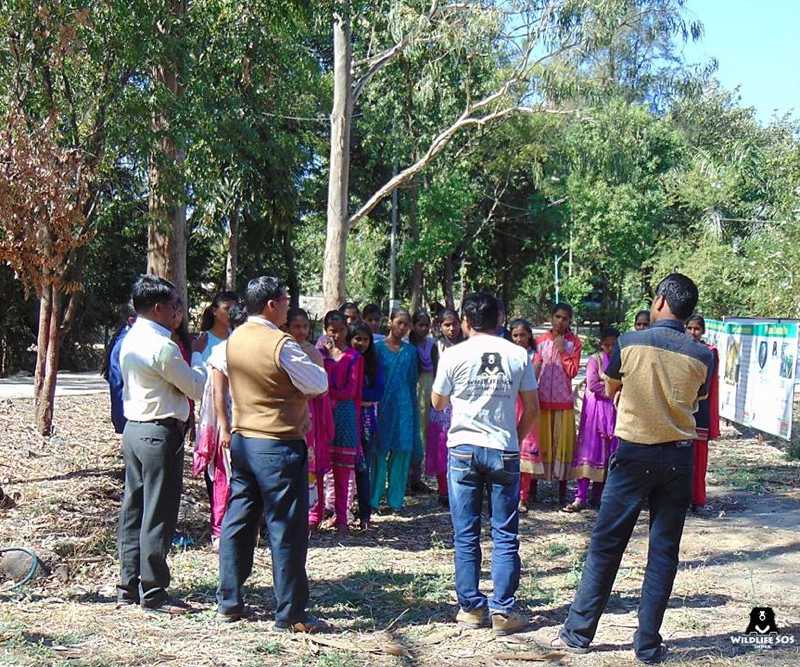
The Manikdoh Leopard Rescue Centre managed by Wildlife SOS in collaboration with the Maharashtra Forest Department currently houses 31 leopards and provides temporary or life-time care, for leopards injured by villagers. Our team conducts regular training programs detailing “capacity building” for Forest Department staff and for vets in outlining the use of tranquilizing gear. They also provide education to local farming communities thereby increasing their awareness and tolerance for coexistence with these beautiful cats.