
Wildlife SOS’s series “Things You Didn’t Know About” explores fascinating and lesser-known facts about various species. Our writers spotlight one inhabitant of the wild, unveiling its unique characteristics and roles in the ecosystem. In this article, we present one of India’s most widespread mammal species that “flies” in the dark: a bat called the Indian flying fox.
Picture this: dusk is settling over a banyan tree near a quiet village, and suddenly, like a scene straight out of a movie, dozens of large winged creatures stir awake, unfurl their wings, and fly into the sky. Most people who witness this would either freeze or duck. Often mistaken for birds, these winged mammals are none other than bats named as the Indian flying fox, and they are about as misunderstood as any animal can be.

Unlike most bats, Indian flying foxes don’t use echolocation, as their large eyes and sharp sense of smell help them locate fruits and flowers in the dark. [Photo © Wildlife SOS/ Suryoday Singh]
The Indian flying fox (Pteropus medius) is India’s largest bat, and one of the largest bats in the entire world. It is also known as the greater Indian fruit bat. Yet despite the vast range this species occupies, there’s very little about it that people actually know to be true. Let’s explore some of these facts that can also debunk the misbeliefs surrounding bats.
It Really Does Look Like a Fox
The name ‘flying fox’ isn’t just a random, poetic one given, it is genuinely descriptive of what the bat’s face closely resembles. With a long snout, large eyes, and a reddish-brown or yellowish mantle around its neck, the fruit bat, sans its wings, looks far more like a small fox than the bats most people think about. (Zoom into its picture, and you’ll know exactly what I’m talking about.)

Look closely, and the face of an Indian flying fox bears a striking resemblance to that of a fox, which has inspired its very name. [Photo © Wildlife SOS/ Suryoday Singh]
This species belongs to the Yinpterochiroptera suborder, and are classified as megabats owing to their size. These bats have excellent vision to navigate, unlike their smaller cousins who echolocate (they use sound waves for mapping). The Indian flying fox has a wingspan that can stretch up to 1.5 metres (5 feet), making it a genuinely impressive sight in flight.
Unsung Gardeners of India’s Forests
Here is the part most people miss entirely: the Indian flying fox is an ecological powerhouse. Being a frugivore, which gives it its other name, these bats travel considerable distances every night in search of ripe fruit and nectar. As they feed, they carry pollen from flower to flower and scatter undigested seeds far from the parent tree. Sometimes they cover distances that no other animal in their habitat can match.

As they travel between trees to feed on fruit and nectar, fruit bats carry pollen and seeds across vast distances, quietly keeping forests alive. [Photo © Wildlife SOS/ Suryoday Singh]
Research suggests that at least 289 plant species across the tropics depend on flying foxes like this one for their propagation. Think of mangoes, figs, and banyan trees — trees that are culturally and ecologically central to India. The Indian flying fox quietly plays a hand in helping them thrive. So, the next time you enjoy a ripe mango, there is a decent chance that a fruit bat planted its seed.
Social, and Surprisingly Vigilant
Indian flying foxes are highly social animals. They roost together in large, noisy colonies, sometimes thousands strong, on tall trees, largely from the Eucalyptus and Ficus families, typically near rivers or water bodies. These roost sites, often called ‘camps’, are used consistently year after year, and the bats have been shown to be remarkably particular about choosing them.
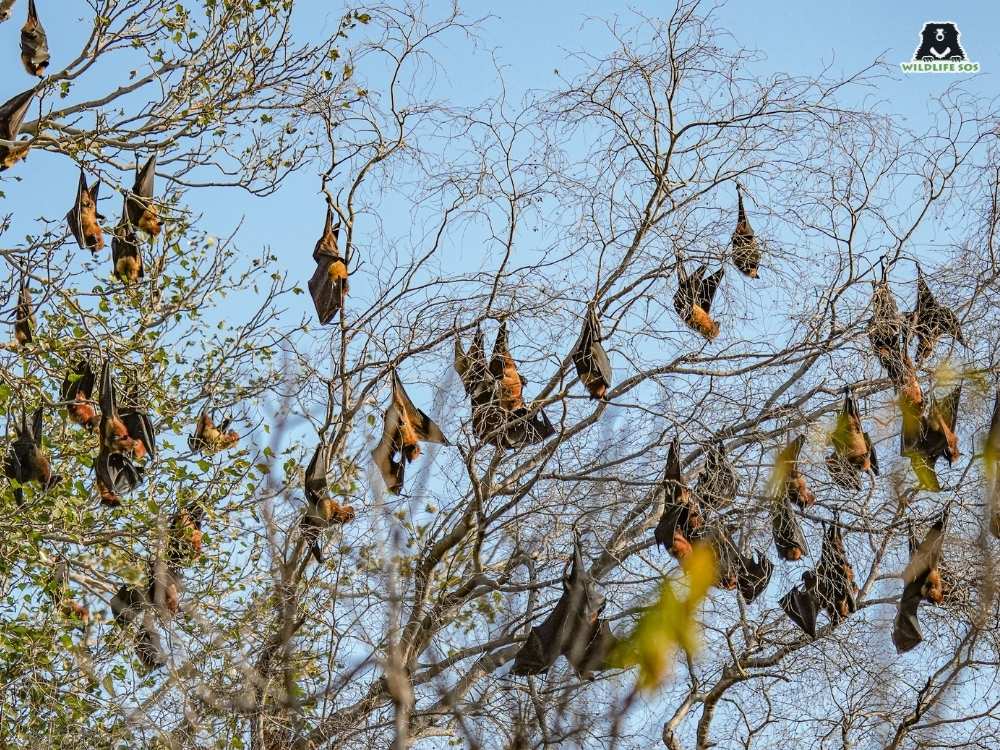
Indian flying foxes roost in large colonies, sometimes numbering in the thousands, on tall trees near water bodies. [Photo © Wildlife SOS/ Suryoday Singh]
What is even more surprising is what happens during the day while they rest. A recent study found that all of these bats do not simply sleep, instead they dedicate a notable portion of their resting time to environmental vigilance, scanning their surroundings for danger. The bats roosting at the edges of a colony are more alert, keeping a watch while the others rest. It is a rather sophisticated social arrangement by an animal that most people aren’t aware of.
Myths Have Made Life Very Hard for Them
The Indian flying fox has to contend with a heavy burden of bad reputation. In parts of India, bat folklore casts them as omens of misfortune, creatures of darkness, or carriers of curses. And adding to this is how they are visually portrayed as spooky beings in horror and thriller films. None of this, of course, has any grounding in truth.

Despite being protected under India’s Wildlife (Protection) Act, Indian flying foxes are still persecuted in parts of the country due to widespread fear and misconceptions. [Photo © Wildlife SOS/ Suryoday Singh]
Flying foxes are still hunted in parts of the country for their meat for use in traditional medicine. Their roosting trees are either cut down when people consider a bat colony as a nuisance, or for projects taken up for urban expansion that is shrinking the wildlife landscape.
The irony is that the very species maligned for hovering near fruit orchards is also one of the primary pollinators that helps those orchards stay productive. The Indian flying fox’s reputation as a pest is one of the more unfortunate misunderstandings.
They Are Protected and Still Vulnerable
Under the original Wildlife (Protection) Act of 1972, fruit bats were placed under Schedule V alongside common crows and rats, a category that meant they could be freely hunted with no legal consequence whatsoever. This classification left the species entirely unprotected despite its enormous ecological value. However, that changed with the Wildlife Protection Amendment Act of 2022, which came into force in 2023. The amendment abolished the old Schedule V entirely, restructuring the Act into four schedules. The Indian flying fox now falls under Schedule II, meaning it finally has legal protection, and hunting it is no longer freely permitted.
The threats, however, have not disappeared with the legal upgrade. Removal of trees removes their food and their resting places. Power lines pose fatal hazards. Urban encroachment brings them into conflict with humans. And in some communities, hunting continues despite legal protections.

To protect the declining population of Indian flying foxes, it is essential to identify and protect the fruit and roosting trees they rely on. [Photo © Wildlife SOS/ Suryoday Singh]
Once considered a species of Least Concern, a thorough study on the Indian flying fox has led its status to now enter the Near Threatened category of IUCN’s Red List of Threatened Species, reflecting growing pressure it is facing from heat stress, habitat loss, and other climate-related risks.
The Indian flying fox is, in many ways, a victim of its own appearance. It is large, it is mainly nocturnal, it roosts in masses and flies at dusk. These have historically invited suspicion, and ignorance, from those who never considered delving deeper into these flying mammals.
But when you do pause and get to know about them, what you find is a remarkable mammal: a crucial pollinator, a long-distance seed disperser, and a highly social animal with complex behaviours that scientists are only beginning to fully understand. India’s forests owe a quiet but significant debt to the flying fox, and perhaps the least we can do is extend a little effort in learning the truth about them. This will help us set aside the myths, and support their conservation before the pressures they face are hard to reverse.
Wildlife SOS runs four 24×7 helplines that address calls concerning animals found in distress. We have been rescuing bats that are victims of sudden collisions or dehydration. If you find one in distress from the following regions, please reach out us:
Delhi NCR: +91-9871963535 | Agra & Mathura: +91-9917109666 | Jammu & Kashmir: +91-7006692300 | Vadodara: +91-9825011117
To know more amazing facts about animals, subscribe to our newsletter.
Feature image: Suryoday Singh/ Wildlife SOS