
Every year, lakhs of olive ridley sea turtles return to the shores of Ganjam in Odisha. What’s fascinating is that many of them were born there decades earlier. After travelling across vast stretches of the Indian Ocean, they are able to navigate back to the same coastline.
But the coast they return to is fast changing.
Concretization, port expansion, fishing vessels move through traditional breeding waters, plastic drifts in the tide, and sound and light pollution disorient hatchlings. The very shoreline that secured their population is now threatening their survival.

Ancient Mariners: The World’s Sea Turtles
Sea turtles first appeared in the oceans more than 100 million years ago, long before modern coastlines formed. Today, seven species of sea turtles exist worldwide, all facing extreme challenges to survive. These are the leatherback turtle (Dermochelys coriacea), the green turtle (Chelonia mydas), the hawksbill turtle (Eretmochelys imbricata), the loggerhead turtle (Caretta caretta), the flatback turtle (Natator depressus), the Kemp’s ridley turtle (Lepidochelys kempii), and the olive ridley turtle (Lepidochelys olivacea). Each is anciently diverse and distinct in shape, diet, habits, and preferences of home.
The leatherback sea turtle is the largest of them all. It is a deep-diver that can descend over 1,000 metres, feeding almost entirely on jellyfish. The hawksbill sea turtle is the reef specialist, its narrow, pointed beak evolved precisely to extract sponges from coral crevices, a diet so specialised that no other species has claimed it. It is also Critically Endangered as per the IUCN Red List of Threatened Species, its shell having made it the target of trade for centuries.

The green turtle is the only herbivorous sea turtle, grazing on seagrass meadows and algae, and in doing so, maintaining the health for the entire ecosystem that depends on them. The loggerhead sea turtle, named for its broad, powerful head, crushes hard-shelled prey, crabs, conchs, horseshoe crabs, that other species cannot manage. The flatback sea turtle nests exclusively on the Australian coast and never ventures beyond the continental shelf, perhaps the most geographically constrained of all seven.

The Kemp’s ridley is the rarest marine turtle in the world. Its entire global population nests on a single stretch of beach in Mexico. The most abundantly found sea turtle of the world is the olive ridley sea turtle, and yet abundance, as Ganjam beaches make clear, does not promise them safety. This turtle’s population is decreasing, now listed as Vulnerable by IUCN.

Together, these seven species play roles that entire ocean ecosystems depend upon. They move nutrients between the ocean and beach. They maintain seagrass beds and coral reefs, and transport nutrients between the sea and beaches. They are the guardians of ecological systems of sustenance as keystone species. Remove them, and the systems they support begin to unravel in ways that are difficult to predict and nearly impossible to reverse.
All sea turtles face the same cluster of threats: habitat loss, bycatch in fishing gear, plastic ingestion, egg poaching, coastal development, light pollution, and climate change reshaping both nesting beaches and the prey they depend on. In India, five species of marine turtles are found: olive ridley, green turtle, hawksbill, leatherback, and loggerhead, all protected under Schedule I of the Wildlife Protection Act, 1972, which grants them the highest level of legal protection in the country. The populations of all five are declining.
Among them, the olive ridley turtle is the most abundant and is one of the smallest sea turtles of the world. It is also one of the few species known for arribadas, a Spanish word for mass nesting events in which thousands of females emerge on the same beach over a short period!
India’s eastern coastline hosts the largest arribadas on Earth! Odisha’s beaches, particularly the mouths of Gahirmatha, Rushikulya, and the Devi River, form the core sites for olive ridley turtles nesting.

The Shore that Olive Ridleys Chose
Ganjam’s Rushikulya coast hosts one of the planet’s most remarkable wildlife gatherings: numerous migratory birds like bar-tailed godwit and Eurasian whimbrel that come from Siberia and Alaska, the Bengal fox, sea snakes, brahminy kites, and a lot more!

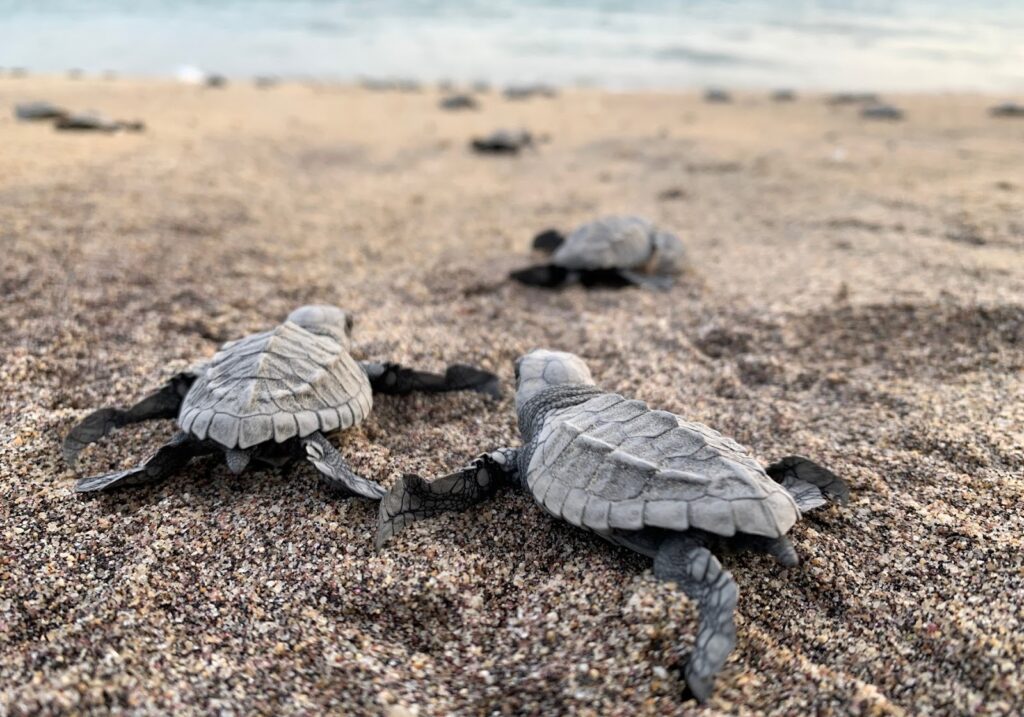
During an arribada, thousands of female olive ridleys emerge from the Bay of Bengal and in an extraordinary synchrony, spread across the shore to lay eggs.
The mothers dig the nest chambers with rear flippers, and use all four for rotation of the sand. They cover the nest with sand before returning to the sea, never to meet the offspring. They lay around 60 to 100 eggs, sometimes even more than 100! The eggs incubate beneath the sand for about 45–60 days.
Many of these turtles likely hatched on the same shore two decades earlier! Studies suggest that hatchlings imprint on the magnetic signature of their birth beach, enabling them to locate the same coastline when they reach maturity.

The scale of nesting at Rushikulya is extraordinary. In 2023, more than 6.37 lakh olive ridley turtles nested here in a single season, and in 2025 nearly seven lakh females arrived within just ten days, the largest nesting recorded in two decades. Such numbers demonstrate both the resilience of the ecologically sensitive species and the importance of the unique coastline. And yet, it is here where a high mortality rate of olive ridley turtles are also recorded.
Mating in a Minefield
Before nesting begins along Ganjam’s coastline, olive ridleys gather in near-shore waters to mate. These waters are legally protected during the breeding season that takes place between November and May. A 20-kilometre no-trawling zone prohibits mechanised fishing vessels from operating close to the nesting beaches during this time. The regulation is designed to reduce turtle mortality. Yet, enforcement of this remains ignored and forgotten.
When turtles become trapped in trawler nets, they cannot reach the surface to breathe. Many drown before the nets are retrieved. Since 2000, over two lakh dead olive ridley sea turtle carcasses have been documented along the coast of Odisha, with most deaths linked to bycatch in trawl and gill-net fisheries.
A simple solution exists, but lacks large-scale enforcement. Turtle Excluder Devices (TEDs) fitted into trawl nets allow turtles to escape while retaining most of the catch. Studies have shown these can reduce turtle bycatch by up to 99%. Despite this, adoption of this mechanism remains limited in many areas.

In 2025, it was reported that thousands of turtle corpses were washed ashore along the Eastern coast of India when masses of them were arriving there. Sea turtles are primarily threatened by trawlers and their rotor blades, and these trawlers don’t have TEDs that can prevent accidents. The carcasses along the shore eventually become the feed for stray dogs and wild boars, along with predators who take advantage of the eggs laid.
Tears of Plastic
Plastic pollution has become a serious non-negotiable threat along the coast.
During necropsies of stranded turtles, researchers have found plastic fragments and fishing net material lodged inside digestive tracts. Floating plastic bags can resemble jellyfish, which the olive ridleys love to feed on the most.
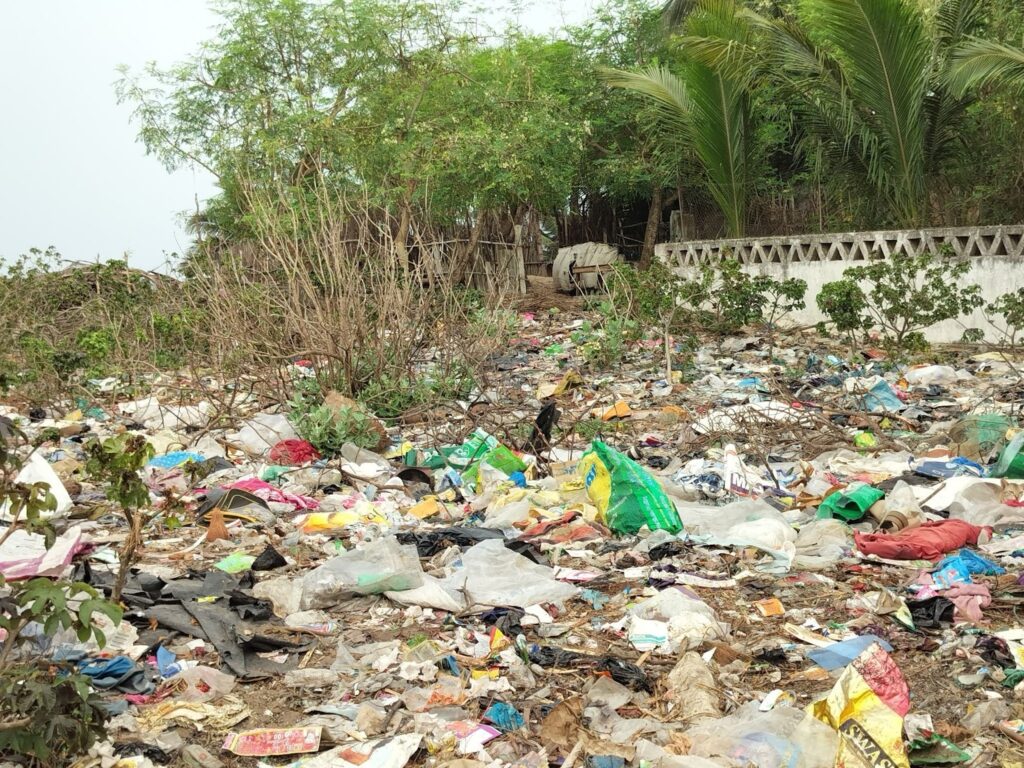
Globally, microplastics have been documented in all seven sea turtle species. These tiny particles can carry toxic chemicals into tissues, disrupt digestion, and potentially move through the food chain.
Is That the Moon’s Light?
When hatchlings emerge from the sand, they instinctively move toward the bright horizon. For millions of years, this light came from the moon reflecting off the sea.
Today, artificial lighting from highways, buildings, and ports can disrupt this navigation. Hatchlings sometimes crawl inland instead of toward the water, where dehydration and predators await.
Artificial lights can also discourage nesting females from emerging onto beaches.

Research shows that more than half of global sea turtle nesting areas are affected by light pollution. Simple changes—such as using amber lighting (which are within specific wavelengths that do not disrupt turtles’ vision), installing shielded fixtures that direct light downward, and using motion-sensor lighting can greatly reduce these disturbances.
However, such measures are still rare along many developing coastal corridors.
Born in a Warming World
All marine turtle species have no chromosomal instruction that determines sex. Whether a hatchling is born male or female is decided entirely by the temperature of the sand around its nest during incubation.
Cooler nests, below about 27.7°C, produce mostly males, while warmer nests, above 31°C, produce mostly females. Long-term monitoring at Rushikulya suggests that nesting seasons now produce approximately 71% female olive ridley hatchlings, reflecting warming nest temperatures.
Because Odisha hosts one of the world’s largest olive ridley populations, changes here will definitely influence the long-term resilience of the species.

Co-existence & Conservation
For generations, traditional fishing communities along the Ganjam coast used small wooden boats and simple jute or cotton nets close to shore. Ganjam is still one of the few places where traditional fishing still exists, but now, humongous trawlers are superseding them. While small-scale practices coexisted with turtle nesting, the arrival of mechanised trawlers have altered that balance, spelling doom for the marine reptile. Industrial fishing vessels can fish for longer durations and deeper depths, increasing pressure on marine ecosystems and eradicating the small-scale fishers. Trawlers are known to destroy the sea bed completely, disseminating corals and grass.
The 20-kilometre no-trawling zone, designed to protect both turtles and coastal livelihoods, is strictly followed in Gahirmatha Marine Sanctuary. But in Rushikulya, Ganjam, its lack of enforcement is making both wildlife and traditional fishing communities suffer.
The Last Window of a Forgotten Memory
Near the Rushikulya coast once stood Podampetta village, home to hundreds of families.
Over the years, waves slowly claimed the settlement. Houses collapsed, roads disappeared, and most residents were forced to relocate inland.

Coastal erosion along Odisha’s shoreline has intensified due to rising sea levels, port expansion, altered sediment flows, and developmental and infrastructure development. Most of the industries are at coasts in Odisha.
Between 1966 and 2015, sea levels along the Odisha coast rose by about 9.5 centimetres. Studies suggest that by 2050 nearly half of the state’s 480-kilometre coastline may experience erosion.
For coastal communities, this means displacement. For olive ridley turtles, it means the disappearance of nesting beaches, which is equally critical.
Shifting Sands
The beaches of Odisha contain roughly 24% of India’s monazite-based thorium, a valuable source used to generate electricity.
Mining such sands would require excavation, machinery, lighting, and infrastructure directly on the coastline. For olive ridley turtles that require undisturbed beaches to nest, such activities could fundamentally alter the habitat.

In rivers like Rushikulya, the same sand represents two very different futures—one for energy (thorium) extraction, and another for wildlife conservation.
Hope?
The solutions to many of these threats are already known. Enforcing the 20-kilometre no-trawling zone, mandating Turtle Excluder Devices, reducing coastal light pollution, improving plastic waste management, and protecting natural shorelines could significantly reduce olive ridley turtle’s mortality rate. None of these solutions require intensive technology, just compassion and serious consideration.

The Sun Yawns
During the silent dawn hours, when the sun is still yawning, a female olive ridley turtle carefully crawls ashore. She digs a nest in the sand and lays a clutch of eggs before returning to the sea. The nest will incubate beneath the beach for several weeks, before birthing hope.
If conditions remain suitable, hatchlings will eventually emerge and move toward the ocean. Only a small fraction survive long enough to return decades later. Their return depends on one simple condition, that the beach where they began still exists.
The olive ridley is listed as Vulnerable on the IUCN Red List, which is the first category that falls under threatened species. Controlling its decline can be done by the choices made to save the coasts it depends on.
How You Can Help
Wildlife SOS works across India to protect wildlife through rescue, research, and community engagement. Every step in wildlife conservation is guided by knowledge, awareness and sensitivity. By making a donation today, you help Wildlife SOS rescue the most vulnerable beings.
Feature Image: Reeshmal