It was a day back in 2007, when under a tepid sun, as the winter chill began to flee, a two-month-old sloth bear cub was struggling to get up in the forests of West Bengal. Perhaps he was trying to look for his mother. The cub’s body was extremely thin and malnourished. He was visibly ill. A purulent discharge ran from his nose and parasites had infested his body. The baby bear’s breath was fading fast but the mother was nowhere in sight. The West Bengal Forest Department waited for her return, until it turned out that waiting was only going to cost the cub his life. He needed urgent medical attention and intervention was the only way to go.
The sloth bear cub was brought to the Agra Bear Rescue Facility (ABRF) for a lifetime of care. Soon after his arrival, he was diagnosed with anemia, which was understandably causing him his lack of appetite. The team of adept veterinarians rallied to heal him.

Fortunately, the cub was able to recuperate and in time, acclimated to his environment. As returning to the wild was not a possibility, it was imperative that the cub remain at the rescue facility for lifelong care. Sloth bears rely on their mothers for no less than two years, during which time she guides them on techniques to survive so they can chart their own individual path in the wild. This cub never got that chance – the chance to piggyback on his mother while she browsed for food, dodged predators and kept him safe under her care. Though this is what he lost, we breathe a sigh of relief that he was found, just in time, so he could live. The team diligently worked towards providing him with all the necessities of a natural environment that would hone his inherent instincts.
Thus began Bizi’s busiest days.
It was the intent observation from the team of veterinarians and caregivers into the cub’s personality that encouraged them to peculiarly name him Bizi. He had a way of never being bored, never remaining idle, and always seemed a little preoccupied with something or another.

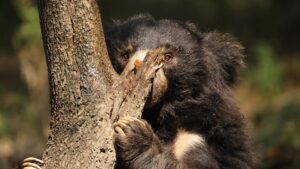
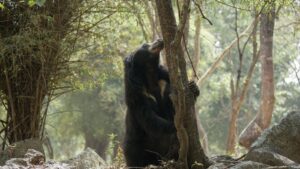
As the leaves of the trees would sway with the wind, Bizi would climb their trunks to his heart’s content. He sits on the perfect branches, ones that give him a cosy resting spot so he can take in the view.
On one of his climbing expeditions during his younger years, Bizi unfortunately faced a minor injury. The bear lost his grip while descending a tree and ended up rubbing his genital area against the trunk. The friction from the tree bark caused a laceration. The team, however, did not panic. What caused them not to was that Bizi was attuned to a process called target training that is duly followed at our rescue centre. This system helps the veterinarians carry out routine medical care with minimal stress to the animal. Bizi’s injury therefore was confidently and safely addressed. He was guided to sit in a new position for ease of medical examinations and treatment of his penile wound. To make him more comfortable, he was rewarded his favourite treat, honey, for the same. A port was also created in his enclosure to facilitate his treatment. This along with regular dressings helped Bizi’s sensitive wound heal perfectly. But his habit of still sitting in the same position in the hope of getting more of his beloved honey is what keeps the team highly amused!

Bizi, now 19-years-old, has slightly mellowed down. He does not climb trees as much as he used to, but they remain special to him. Nowadays, he sits leisurely against the trunk and sometimes searches for ants and termites. And Bizi knows how to work smart and not hard! Digging for ants and termites can get tedious, after all. So, he keeps a lookout for dark clouds and the rain that follows. He is patient and almost meditative during the downpour. As soon as the skies clear up, he gallops happily towards familiar spots where ants and termites are bound to emerge from in the wet soil so that clever Bizi can gobble up his feast.

Now that he has stepped into his golden years, Bizi’s days are marked with focused geriatric care. Courses of liver supplements and multivitamins are prescribed to Bizi twice a year. These additions are mixed in her meals to help an aging liver process nutrients and regulate proteins more efficiently.
To support Bizi’s appetite, he is served a nourishing multimillet porridge and fruits. He is especially fond of freshly cut fruits, and blissfully devours mangoes when he gets them! Bizi is known to pick out the juicy mangoes from the fruit platter first, and only after these does he move on to watermelons, sunmelons, muskmelons, apples and papayas.

Bizi has not always been busy alone. When he had first arrived at ABRF, he had the verdant enclosure to himself, but little did he know he would be joined by another rescued sloth bear soon. This was Karthikayani, almost the same age as Bizi’s, who had been caught in the ‘dancing’ bear trade. Karthikayani became a sister to Bizi, who would more than often be a bossy one! Bizi would know when to keep a polite distance from her, and the two were staying together peacefully.
In the following year of 2008, another female sloth bear, rescued from the heinous practice, joined their living space. Arshitha was a year older than the sibling-like duo. Despite her guarded demeanor, it was Bizi who found a way to make their interactions friendly and comfortable. Till this day, the three are often seen hanging out together. They even share a den sometimes to sit together, especially when the sun seems unrelenting.
What we know for certain is that Bizi does not like to be in the water at all, even during summers. While Karthikayani and Arshitha occasionally go into the pool in their shared enclosure, Bizi refuses to even put a paw in to test the temperatures. But that doesn’t matter much as there are many other enrichments that keep Bizi busy!
The hammock makes for his favourite one! He keeps swinging it as he relaxes under the shade of a tree, making him beat the heat. Bizi’s hammock is moved in the winter towards a sunnier area. He loves to lounge there to bask for a prolonged period. Bizi also likes to solve puzzle feeders that are filled with dates and pieces of coconuts. The ursine knows how to masterfully use his curved claws to extract the treats.

Bizi has built a full life at ABRF. Even though every year makes him older, he remains engrossed in the happy hustle and bustle of the field he resides in. Be it mangoes in the summer, an abundance of ants and termites in the monsoon or a sunny disposition of his hammock in the winter. Bizi continues to remain true to how his name is pronounced, with great assistance from Karthikayani, Arshitha, the nurturing team of caregivers and veterinarians.
You can contribute to maintaining the healthy and peaceful lives of our rescued sloth bears by becoming a monthly supporter.
Feature Image: Mradul Pathak/Wildlife SOS