Bannerughatta National Park in Bengaluru, Karnataka, is where scores of species find a safe and secure home. Within this sanctuary lies the Wildlife SOS Bannerughatta Bear Rescue Centre (BBRC), a dedicated shelter for rescued sloth bears. Common to both are those that cross trees and the meandering stream with their ability and freedom to fly. Let’s introduce you to more birds of Bannerughatta, captured through the eyes (and camera lenses!) of our staff. This is part II of a series of three articles.
In Part I of the series, we entered the Bannerughatta Bear Rescue Centre (BBRC) with our binoculars in search of elegant birds. Not only did we appreciate their beauty, but we also learned incredible facts about them. But a single blog was not enough to bring to you the diversity that exists in this rich ecosystem. Let’s sharpen our eyes further to spot the birds we are now about to mention. Some of them are fast flying, and some have mastered the art of camouflaging with the environment. Here’s our second exploration of birds found at the rescue centre, along with fascinating facts about each!
1. Plum-headed Parakeet
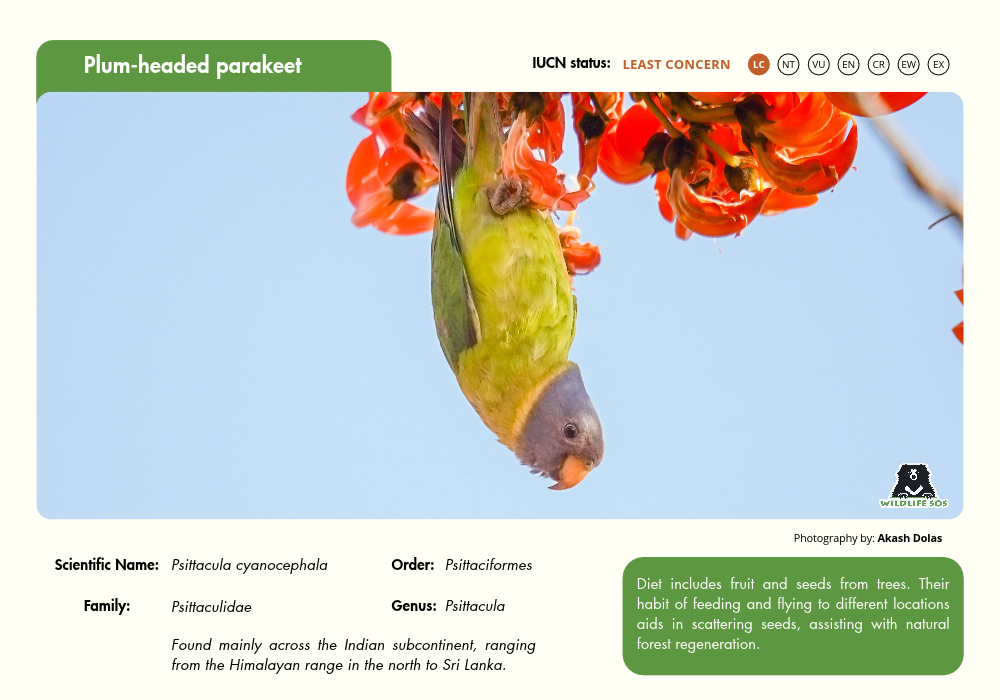
We often come across parakeets with a head in the shade of plum-like red! While they wear green on their body, nature’s common colour, their members also sneak in tones of purple and blue that are classified as colours rare in nature.
- These parakeets exhibit dimorphism, which means the males and females do not look alike; the male individuals wear more prominent colours than the females do. Plum-headed parakeets are named after the males since they have a deep red coloured head that resembles a plum peeking out of leaves! These red heads have a purple hindcrown around the nape and lower cheeks. They also have a red patch on their wing that resembles a tiny splash of paint. These are absent in females, who have their heads coloured in a pale blue, gray shade.
- The majority of their diet is fruits.
- Plum-headed parakeets are extremely social. They remain within their flocks and chirp in a high pitched sound “tui-tui-tui-tui”, which can be more elaborately described as “toowinck-toowinck”.
2. Jerdon’s Leafbird

The Jerdon’s leafbird is a spitting image of a green emerald leaf. The females flaunt a much greener head than the males, and have a pretty shade of turquoise blue visible on their throat. Males wear a stark dark blue-black patch, and because it extends to their eyes, it does resemble a mask — with a tuft of iridescent violet within it.
- This bird’s call is so varied, they not only squeak loudly, but also mimic other birds, which provides them with a classic defense against predators.
- Jerdon’s leafbird lounges around on high branches of trees, almost camouflaging in-between leaves. They also choose to create their nests in dense upper canopies, escaping predators this way.
- Leafbirds exhibit a very interesting behaviour. They are known to shed their feathers when they are in a stressful situation. This can fool predators too that manage to grab only a fluffy cluster instead. Leafbirds also undergo natural shedding of feathers every year. This process is called molting, after which fresh feathers emerge on their body.
3. Oriental Darter

The Oriental darter is easily recognised by its most prominent feature, its long, slender and snake-like neck. Because of this, it is also very commonly known as a snakebird. Males and females look similar, with changes being less evident. They can be observed either sitting on low branches right next to water bodies, or gracefully gliding over one before settling on its surface.
- The bird’s vocalisations include hoarse croak-like “kah-kah-kah” calls. At times, they also let out hisses during breeding season (another snake-like characteristic) and clicks. Darters mostly stay alone, except during breeding season. They use their calls and flap their wings to attract mates. Wing flapping and upward stretching of their necks can also be seen when they perceive danger.
- Darters are extremely skilled fishers. They hunt aquatic life by completely immersing themselves into the water, appearing with the fish in their beak that they toss and take in, mouth first!
- This water bird is usually seen basking on trees with its wings partially parted out so they can be dry before their next dive in to seek prey.
- Worsened state of wetlands is leading to habitat loss, while felling of trees surrounding the waterbodies are uprooting their nesting sites, thereby affecting their population, making them come under the Near Threatened category of IUCN’s Red List of Threatened Species.
4. Indian Grey Heron
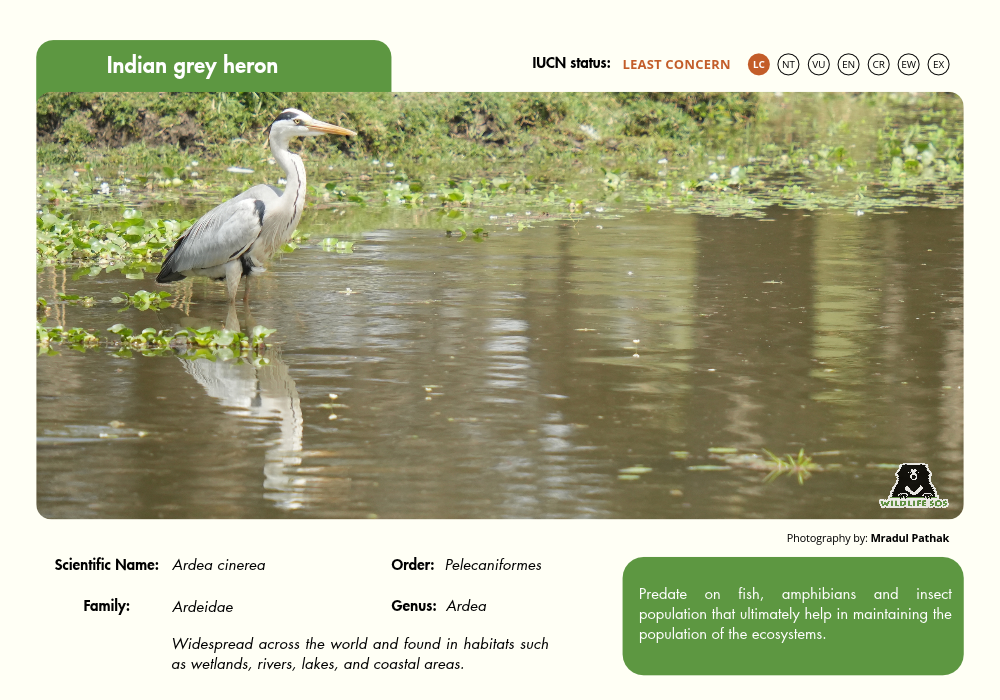
The grey heron is nothing less than a picture of patient elegance. Like most pescivorous (fish-eating) birds, it has a long slender neck that aids in fishing. These birds exhibit minimal sexual dimorphism, meaning the males and females look almost exactly alike.
- The grey heron’s call is very unique, sounding like someone is calling their friend “Frank”! The vocalisation goes like “fraaaank”, typically mid-flight. Attentive herons may produce a call sounding like “go-go-go”.
- Unlike its fellow waterbird the oriental darter, grey herons are ambush predators that do not fully immerse themselves in water. Instead, this bird waits motionless at the edge of the water body for a while for a fish to come close enough, and that’s when it swoops its beak for it.
- Grey herons are known to be opportunistic feeders. They will feed on fish, but also on amphibians and young waterbirds. When they are close to harvest lands, they can be seen preying on rodents and small reptiles too.
5. White-throated Kingfisher
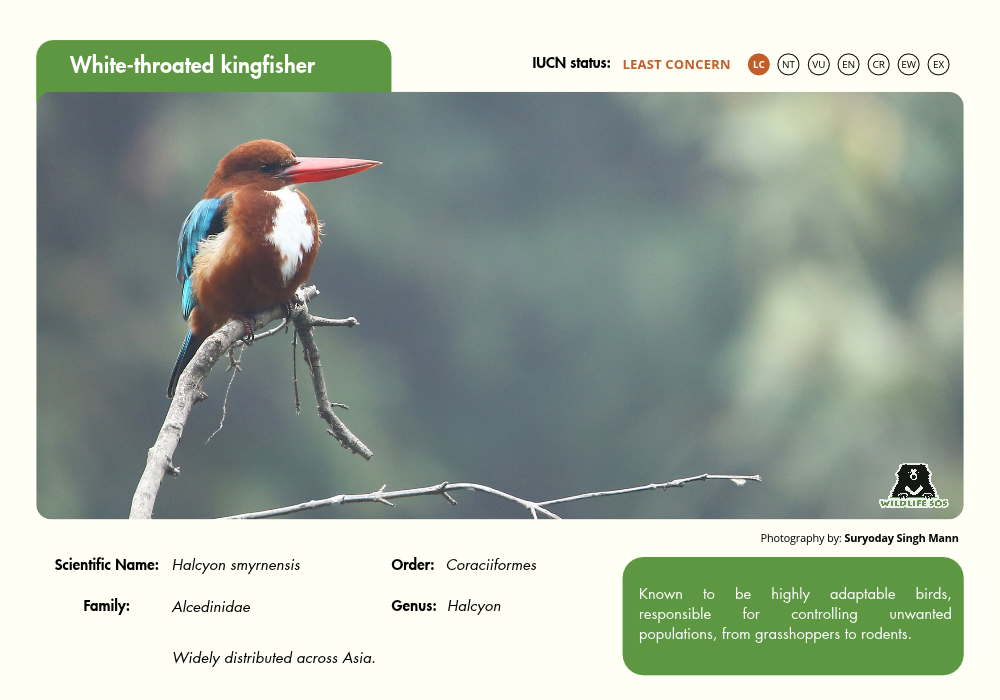
The striking turquoise blue colour of this kingfisher’s wings can be spotted even from a distance. Both the male and female appear the same with a reddish-orange coloured bill and a white chin, throat and breast. The juveniles are a bit duller in colour.
- White-throated kingfishers are extremely vocal. Their calls have a certain sharpness to them that goes “kilililili” as a whistle, repeating after short gaps. The calls are more frequent during their breeding season.
- They are known to be opportunistic hunters with a varied diet of insects, scorpions, lizards, fish (which is reflected in their name) and even crabs.
- They are perch-and-pounce predators that are found far from water bodies too. These kingfishers eye their prey from atop a branch or wire, swoop to grab them ever so silently, and return to the very spot they took off from to enjoy their meal.
6. Common Hoopoe
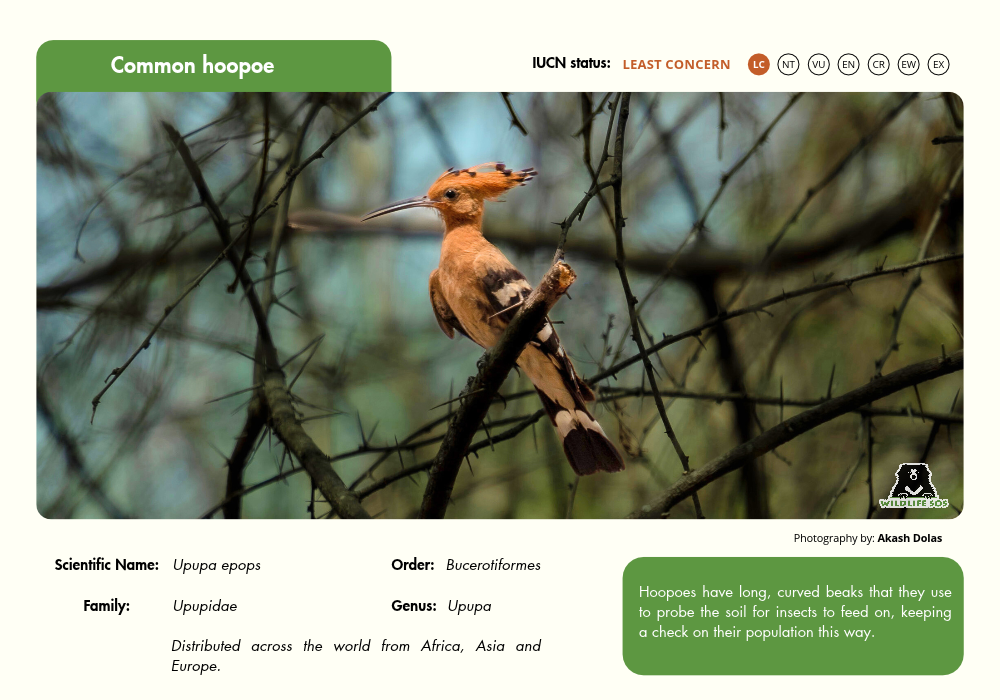
Common hoopoe, also called Eurasian hoopoe, belongs to the family Upupidae that comprises three living species. The fourth member – Saint Helena hoopoe – sadly went extinct in the early 16th century. Hoopoes are very eye-catching birds, with their most striking feature being the fan-shaped crown of feathers they have. This hairstyle is similar to the mohawk haircut for people! The hoopoe folds its black-tipped crest while engrossed in foraging, and opens it up when it is alert or during courtship displays. Only a very sharp observation can reveal that the females are coloured more dull than the males, and are also slightly smaller in size.
- Hoopoes make a soft yet distinctive call of “hoo-poo” or a repetitive “oop-oop-oop”, which gave them their very name.
- These birds primarily are mostly ground-dwelling and feed on insects. To help its appetite, the bird has a gently curved, long beak that can probe the soil for earthworms and insects including larvae among the fallen leaf litter.
- A hoopoe’s flight is undulating, much like that of a butterfly, flitting from one place to another.
7. White-bellied Drongo
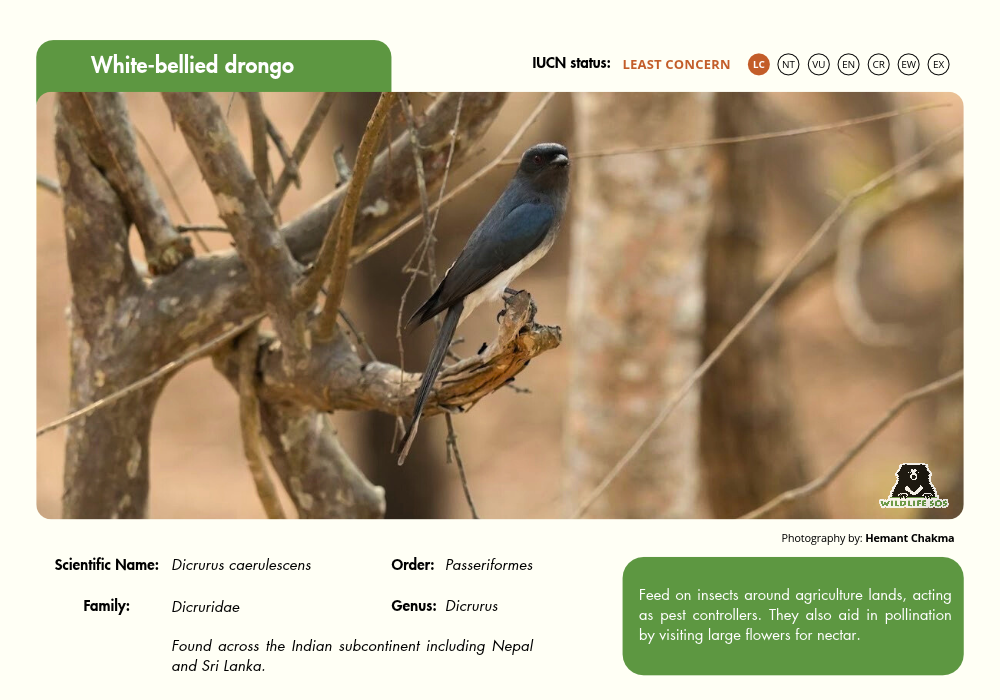
One particular feature acts as an instant revelation when one is searching for a drongo: its deeply forked tail. One can then move on to understand which of the 10 drongo species found in India has been seen. White-bellied drongos have a very slender body. They wear a glossy black coat with a highly contrasting white belly. These birds are one of the smaller-sized drongos. Both the sexes have the same features, making them indistinguishable from each other. Their sister species, the black drongo, can also be spotted widely, but they only have a tiny spot of white at the base of their beak.
- White-bellied drongo’s vocalisation skills are something to envy. These drongos can excellently mimic sounds, even if it is the “meowing” of a cat!
- The drongo’s primary diet consists of flying insects such as moths and flies. They are aerial hunters and would fearlessly dive to catch their prey mid-flight. And if they are not catching insects, they are probably feeding on nectar from large flowers, or boldly hunting for smaller birds.
- You are most likely to spot a drongo perching on a branch alone, and if luck is on your side, you might find three together, not more. That’s odd, isn’t it?
8. Red-whiskered Bulbul
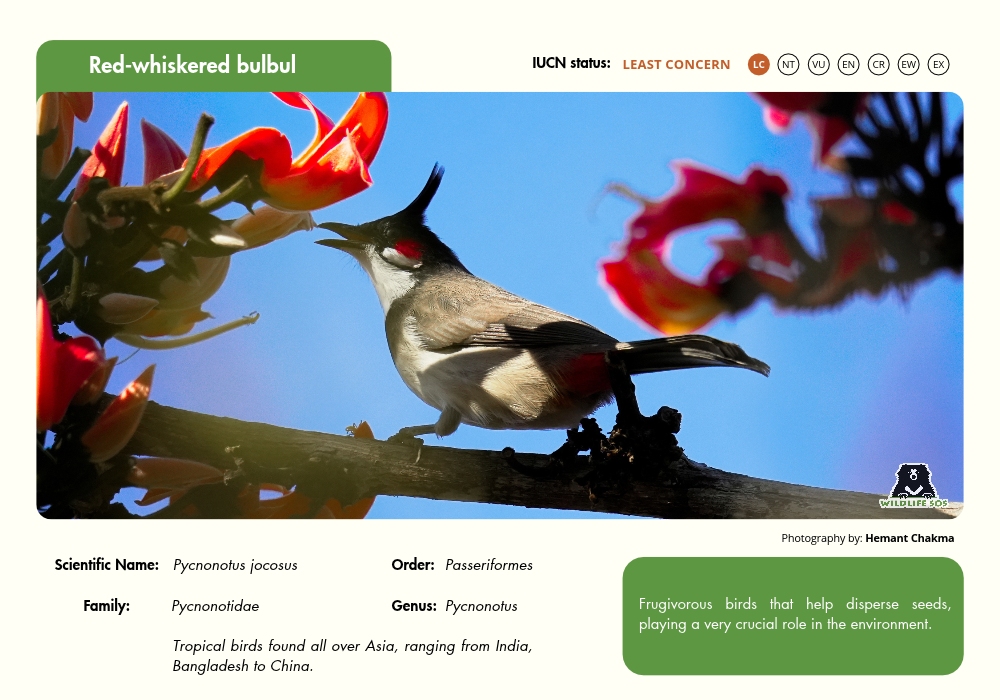
The red-whiskered bulbul has two very distinctive features. One is their impeccably styled black crest, which gives hairdressers a run for their money! The second one is mentioned in its name itself – the ruby red patch behind their eyes, right above the striking white cheeks. Both male and female bulbuls are gifted with these gorgeous features, elegantly dodging the whole dimorphism model!
- These bulbuls have incredibly adorable calls that go along the lines of “kink-a-joo”, a melodious tune for anyone who is lucky enough to wake up to it! But when they themselves are alarmed, they let out fast and repetitive “peep-peep-peep” calls.
- The red-whiskered bulbul is also tough and adaptable. Being completely frugivorous, they love to eat a variety of fruits – even those which are poisonous to mammals. They can easily feast upon yellow oleander berries without fearing a stomach bug!
- Red-whiskered bulbuls can be found in flocks consisting of up to 20-100 of their kind during breeding season. They remain monogamous in this time, making both the male and female equally responsible for feeding their hatchlings!
9. Purple Sunbird
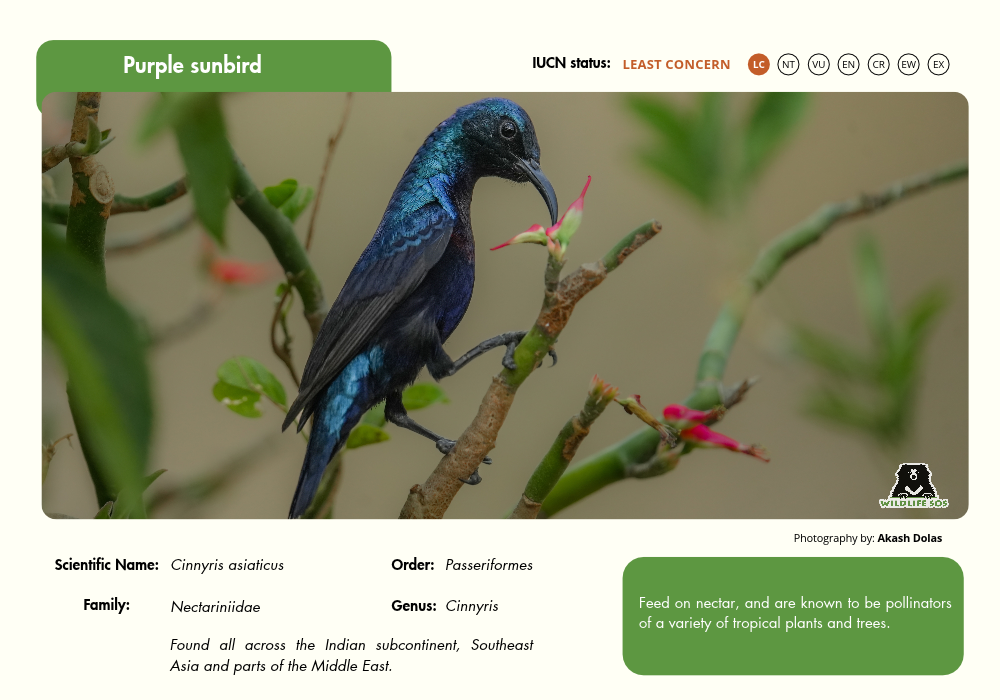
If you’re crossing a tree or bush filled with flowers, watch out for a small, rapidly fluttering bird. Purple sunbirds are tiny birds, and have been named after the males who literally change their colours in the breeding season. Their feathers become a glossy, metallic shade of purple-black. For the remaining months, they look similar to female sunbirds that wear an olive brown coat with pale yellow underparts.
- Purple sunbirds might have a small size, but their high-pitched, loud calls of “cheewit-cheewit” can easily be heard from long distances. You’ll definitely need to follow your ear to trace the bird.
- Purple sunbirds are often seen near flowers because they primarily feed on the sweet nectar they offer. Some often mistakenly call this bird a “hummingbird” because of how it hovers over a flower, but hummingbirds are not found in India at all. Unlike hummingbirds’ long and straight beaks, sunbirds have long and curved beaks that help them to take in nectar from deep within the flowers.
- Parent sunbirds care for their young ones by providing them with a protein diet of insects such as spiders.
- These birds are highly monogamous during breeding season. They are usually seen in pairs or in small groups, but if threatened by predators like an owl, they tend to group up and boldly fend it off!
10. White-throated Fantail
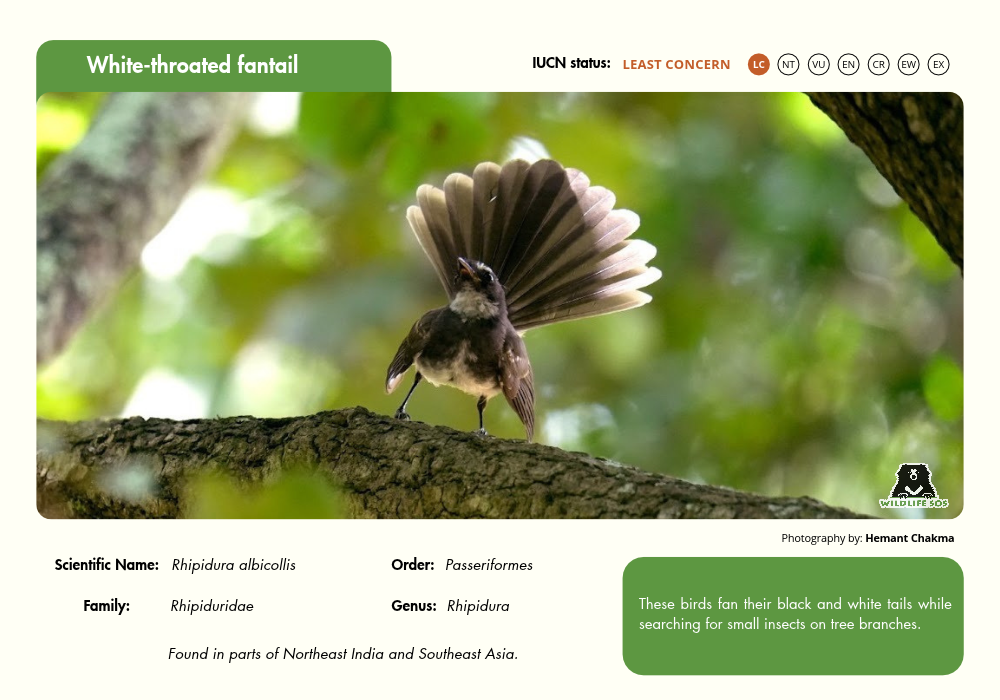
Another small bird that is full of energy is the white-throated fantail. It has a dark grey coat, a clearly distinguished white throat, and a thin white eyebrow that makes the bird look like a character from the game series ‘Angry Birds’! But what truly sets this bird apart from any and every avian spotted in BBRC is its tail. It opens up its feathers to completely resemble a chinese fan.
- They say evolution over time is constant, but these white-throated fantails tend to apply this to their incredible melody quite frequently. After extensive research, it was discovered that every year, fantails add a change to the core song they sing. . These changes that accumulate over four to five years converts the original to a whole new (and tuneful) song altogether.
- When it comes to courtship, the male puts on a show by completely opening up its tail like a fan. As if this display was not enough, the fantail accompanies this with its song to make the females tune in.
- These birds are small birds that remain extremely active. They are constantly flicking their tails, and are fascinating to watch when they hunt for insects – they take short and rapid flights from one branch to another or take quick and clever hops in bushes to catch hold of their feed.
Birds play a more important role than just being easy on the eyes; they are pollinators, pest controllers, seed carriers, and even storytellers of Earth’s ancient past. At BBRC, we’re proud to host such rich avian diversity alongside our rescued sloth bears. So far, we have introduced to the 20 avian species we see out here, but there are still more to reveal! So, keep your binoculars handy for Part III of this bird watching series!
Feature Image: Akash Dolas/Wildlife SOS
Sources: